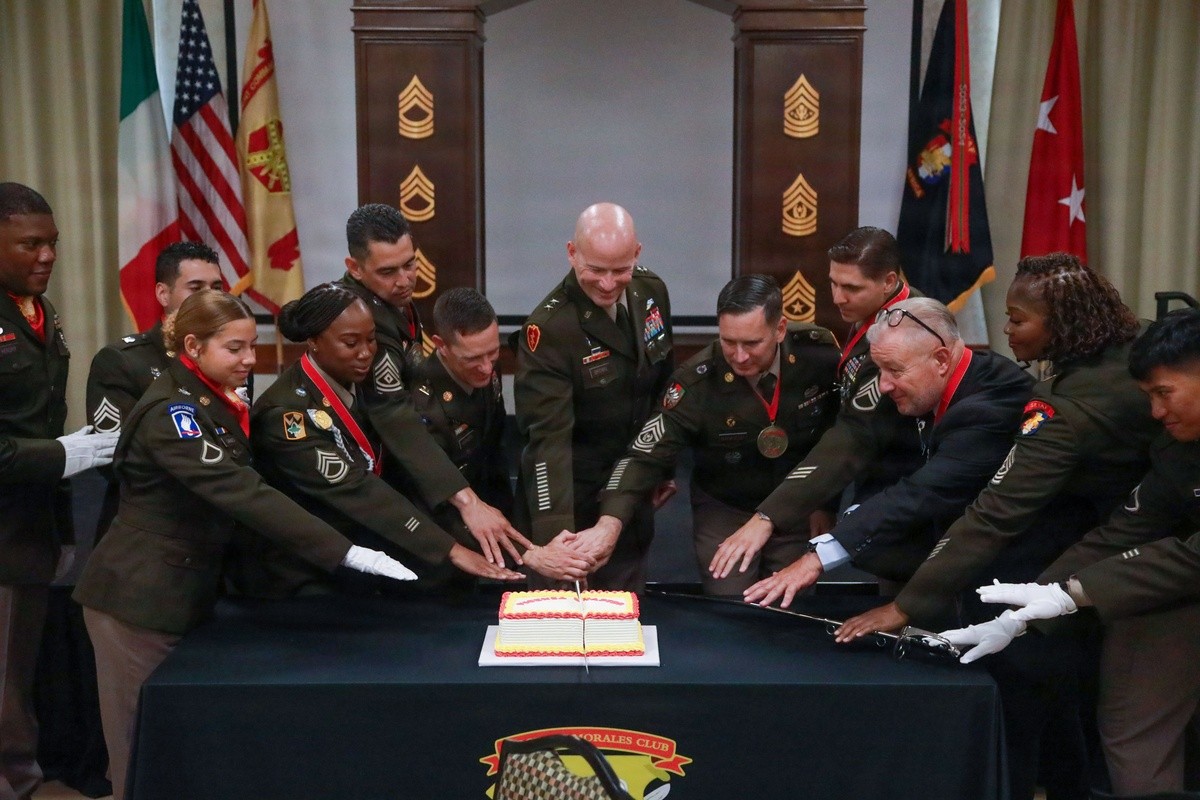
1 / 11Show Caption +Hide Caption –U.S. Army Command Sgt. Maj. Chad B. Harness, senior enlisted advisor, U.S. Army Southern European Task Force, Africa (SETAF-AF), shares remarks during the Sergeant Morales Club induction ceremony at Caserma Ederle, Vicenza, Italy, July 10, 2026. The ceremony recognized exemplary leadership, professional excellence and selfless service while reinforcing the Sergeant Morales Club’s commitment to developing exceptional noncommissioned officers and preserving the traditions of the Army profession. (U.S. Army photo by Cpl. John Garcia) (Photo Credit: Spc. John Garcia)VIEW ORIGINAL2 / 11Show Caption +Hide Caption –U.S. Army Command Sgt. Maj. Chad B. Harness, left, senior enlisted advisor, U.S. Army Southern European Task Force, Africa (SETAF-AF), Italian army Sgt. Maj. (retired) Gaetano Massimo Giordano, Veterinary Readiness Activity-Italy, and Command Sgt. Maj. Garric M. Banfield, command senior enlisted leader, U.S. Africa Command, present Gaetano’s Sergeant Morales Club plaque during an induction ceremony at Caserma Ederle, Vicenza, Italy, July 10, 2026. The ceremony recognized exemplary leadership, professional excellence and selfless service while reinforcing the Sergeant Morales Club’s commitment to developing exceptional noncommissioned officers and preserving the traditions of the Army profession. (U.S. Army photo by Cpl. John Garcia) (Photo Credit: Spc. John Garcia)VIEW ORIGINAL3 / 11Show Caption +Hide Caption –U.S. Army Command Sgt. Maj. Chad B. Harness, left, senior enlisted advisor, U.S. Army Southern European Task Force, Africa (SETAF-AF), Sgt. 1st Class LaDonna Saunders, senior career counselor assigned to the 207th Military Intelligence Brigade, and Command Sgt. Maj. Garric M. Banfield, command senior enlisted leader, U.S. Africa Command, pose for a photo, welcoming Saunders into the Sergeant Morales Club during an induction ceremony at Caserma Ederle, Vicenza, Italy July 10, 2026. The ceremony recognized exemplary leadership, professional excellence and selfless service while reinforcing the Sergeant Morales Club’s commitment to developing exceptional noncommissioned officers and preserving the traditions of the Army profession. (U.S. Army photo by Cpl. John Garcia) (Photo Credit: Spc. John Garcia)VIEW ORIGINAL4 / 11Show Caption +Hide Caption –U.S. Army Sgt. 1st Class LaDonna Saunders, a senior career counselor assigned to the 207th Military Intelligence Brigade, receives the Sergeant Morales Club medallion from Command Sgt. Maj. Garric M. Banfield, command senior enlisted leader, U.S. Africa Command, and Command Sgt. Maj. Chad B. Harness, senior enlisted advisor, U.S. Army Southern European Task Force, Africa (SETAF-AF), during the Sergeant Morales Club induction ceremony at Caserma Ederle, Vicenza, Italy, July 10, 2026. The ceremony recognized exemplary leadership, professional excellence and selfless service while reinforcing the Sergeant Morales Club’s commitment to developing exceptional noncommissioned officers and preserving the traditions of the Army profession. (U.S. Army photo by Cpl. John Garcia) (Photo Credit: Spc. John Garcia)VIEW ORIGINAL5 / 11Show Caption +Hide Caption –Members of the Vicenza military community attend the Sergeant Morales Club induction ceremony at Caserma Ederle, Vicenza, Italy, July 10, 2026. The ceremony recognized exemplary leadership, professional excellence and selfless service while reinforcing the Sergeant Morales Club’s commitment to developing exceptional noncommissioned officers and preserving the traditions of the Army profession. (U.S. Army photo by Cpl. John Garcia) (Photo Credit: Spc. John Garcia)VIEW ORIGINAL6 / 11Show Caption +Hide Caption –U.S. Army Command Sgt. Maj. Garric M. Banfield, command senior enlisted leader, U.S. Africa Command, shares remarks during the Sergeant Morales Club induction ceremony at Caserma Ederle, Vicenza, Italy July 10, 2026. The ceremony recognized exemplary leadership, professional excellence and selfless service while reinforcing the Sergeant Morales Club’s commitment to developing exceptional noncommissioned officers and preserving the traditions of the Army profession. (U.S. Army photo by Cpl. John Garcia) (Photo Credit: Spc. John Garcia)VIEW ORIGINAL7 / 11Show Caption +Hide Caption –U.S. Army 1st Sgt. Alexis O. Morales-Morales, left, first sergeant, Headquarters and Headquarters Company, 2nd Battalion, 503rd Infantry Regiment, 173rd Mobile Brigade Combat Team, presents Command Sgt. Maj. Chad B. Harness, right, senior enlisted advisor, U.S. Army Southern European Task Force, Africa (SETAF-AF) with a plaque during the Sergeant Morales Club induction ceremony at Caserma Ederle, Vicenza, Italy July 10, 2026. The ceremony recognized exemplary leadership, professional excellence and selfless service while reinforcing the Sergeant Morales Club’s commitment to developing exceptional noncommissioned officers and preserving the traditions of the Army profession. (U.S. Army photo by Cpl. John Garcia) (Photo Credit: Spc. John Garcia)VIEW ORIGINAL8 / 11Show Caption +Hide Caption –U.S. Army 1st Sgt. Alexis O. Morales-Morales, left, first sergeant, Headquarters and Headquarters Company, 2nd Battalion, 503rd Infantry Regiment, 173rd Mobile Brigade Combat Team (Airborne), presents Command Sgt. Maj. Chad B. Harness, senior enlisted advisor, U.S. Army Southern European Task Force, Africa (SETAF-AF), with a plaque during the Sergeant Morales Club induction ceremony at Caserma Ederle, Vicenza, Italy July 10, 2026. The ceremony recognized exemplary leadership, professional excellence and selfless service while reinforcing the Sergeant Morales Club’s commitment to developing exceptional noncommissioned officers and preserving the traditions of the Army profession. (U.S. Army photo by Cpl. John Garcia) (Photo Credit: Spc. John Garcia)VIEW ORIGINAL9 / 11Show Caption +Hide Caption –Members of the Sergeant Morales Club and U.S. Army Maj. Gen. Matthew W. Brown, center, commanding general, U.S. Army Southern European Task Force, Africa (SETAF-AF), cut a ceremonial cake during the SMC induction ceremony at Caserma Ederle, Vicenza, Italy July 10, 2026. The ceremony recognized exemplary leadership, professional excellence and selfless service while reinforcing the Sergeant Morales Club’s commitment to developing exceptional noncommissioned officers and preserving the traditions of the Army profession.(U.S. Army photo by Cpl. John Garcia) (Photo Credit: Spc. John Garcia)VIEW ORIGINAL10 / 11Show Caption +Hide Caption –Vicenza Sergeant Morales Club members pose for a photo during the SMC induction ceremony at Caserma Ederle, Vicenza, Italy July 10, 2026. The ceremony recognized exemplary leadership, professional excellence and selfless service while reinforcing the Sergeant Morales Club’s commitment to developing exceptional noncommissioned officers and preserving the traditions of the Army profession. (U.S. Army photo by Cpl. John Garcia) (Photo Credit: Spc. John Garcia)VIEW ORIGINAL11 / 11Show Caption +Hide Caption –Vicenza Sergeant Morales Club members and Dr. Mary E. Walker awardees pose for a photo during the SMC induction ceremony at Caserma Ederle, Vicenza, Italy July 10, 2026. The ceremony recognized exemplary leadership, professional excellence and selfless service while reinforcing the Sergeant Morales Club’s commitment to developing exceptional noncommissioned officers and preserving the traditions of the Army profession. (U.S. Army photo by Cpl. John Garcia) (Photo Credit: Spc. John Garcia)VIEW ORIGINAL
The ceremony inducted two noncommissioned officers into the Sergeant Morales Club, welcomed an honorary member whose continued service strengthened the enduring partnership between the U.S. and Italian armies, and presented the Dr. Mary E. Walker Award to four volunteers whose dedication enhanced Soldier and Family readiness across the Vicenza military community.
The ceremony highlighted the critical role noncommissioned officers and volunteers play in maintaining a ready and resilient force.
Command Sgt. Maj. Banfield, CSM of AFRICOM, speaks at the Sergeant Morales Induction Ceremony, July 10, 2026, on Caserma Ederle, Italy. The Sergeant Morales Club promotes the highest ideals of integrity, professionalism and leadership for enlisted service members serving in Europe. The membership is gained through a rigorous and competitive process. (U.S. Army photo by Sgt. William Thompson.) (Photo Credit: Sgt. William Thompson)VIEW ORIGINAL
“The moment you put on that medallion, people will wonder if you’re one of those board NCOs who only shine under the spotlight,” said U.S. Army Command Sgt. Maj. Garric M. Banfield, command senior enlisted leader, U.S. Africa Command. “Prove them wrong. Seek out the toughest challenges, embrace difficult assignments and become exceptional at leading Soldiers.”
1 / 3Show Caption +Hide Caption –Sgt. 1st Class LaDonna Saunders, Assigned to the 207th Military Intelligence brigade, inducted into the Sergeant Morales Club , July 10, 2026, on Caserma Ederle, Italy. The Sergeant Morales Club promotes the highest ideals of integrity, professionalism and leadership for enlisted service members serving in Europe. The membership is gained through a rigorous and competitive process. (U.S. Army photo by Sgt. William Thompson.) (Photo Credit: Sgt. William Thompson)VIEW ORIGINAL2 / 3Show Caption +Hide Caption –Sgt. 1st Class LaDonna Saunders, Assigned to the 207th Military Intelligence brigade, inducted into the Sergeant Morales Club , July 10, 2026, on Caserma Ederle, Italy. The Sergeant Morales Club promotes the highest ideals of integrity, professionalism and leadership for enlisted service members serving in Europe. The membership is gained through a rigorous and competitive process. (U.S. Army photo by Sgt. William Thompson.) (Photo Credit: Sgt. William Thompson)VIEW ORIGINAL3 / 3Show Caption +Hide Caption –Staff Sgt. Germalm, assigned to the Veterinary Readiness Activity, is Inducted into the Sergeant Morales Club, July 10, 2026, on Caserma Ederle, Italy. The Sergeant Morales Club promotes the highest ideals of integrity, professionalism and leadership for enlisted service members serving in Europe. The membership is gained through a rigorous and competitive process. (U.S. Army photo by Sgt. William Thompson.) (Photo Credit: Sgt. William Thompson)VIEW ORIGINAL
The chapter inducted U.S. Army Sgt. 1st Class LaDonna Saunders, senior career counselor assigned to the 207th Military Intelligence Brigade (Theater), and Staff Sgt. James Germalm, food inspector assigned to Veterinary Readiness Activity–Italy. Retired Italian army Sgt. Maj. Gaetano Massimo Giordano, who continues serving alongside U.S. personnel at VRA–I, was inducted as an honorary member in recognition of his distinguished military career and continued commitment to strengthening the longstanding alliance between the United States and Italy.
Mr. Gaetano Massimo Giordano is honorably inducted int to the Sergeant Morales Club, July 10, 2026, on Caserma Ederle, Italy. The Sergeant Morales Club promotes the highest ideals of integrity, professionalism and leadership for enlisted service members serving in Europe. The membership is gained through a rigorous and competitive process. (U.S. Army photo by Sgt. William Thompson.) (Photo Credit: Sgt. William Thompson)VIEW ORIGINAL
Selection into the Sergeant Morales Club reflects sustained excellence in leadership, professionalism and commitment to the Army Values.
U.S. Army Maj. Gen. Matthew W. Brown, right, commanding general, and Command Sgt. Maj. Chad B. Harness, senior enlisted advisor, U.S. Army Southern European Task Force, Africa (SETAF-AF) command team, present Sgt. Maj. Shannett V. Robinson, president of the Sergeant Morales Club Vicenza Chapter with a certificate of appointment to command sergeant major in recognition of an upcoming assignment during the SMC induction ceremony at Caserma Ederle, Vicenza, Italy July 10, 2026. The ceremony recognized exemplary leadership, professional excellence and selfless service while reinforcing the Sergeant Morales Club’s commitment to developing exceptional noncommissioned officers and preserving the traditions of the Army profession. (U.S. Army photo by Cpl. John Garcia) (Photo Credit: Spc. John Garcia)VIEW ORIGINAL
“The Sergeant Morales Club represents the pinnacle of NCO leadership, character and professional excellence,” said U.S. Army Sgt. Maj. Shanett V. Robinson, chief medical NCO and Sergeant Morales Club president, U.S. Army Southern European Task Force, Africa (SETAF-AF). “Membership is not simply an achievement; it is a lifelong commitment to mentoring future leaders, upholding the highest standards of our profession and preserving the legacy of the NCO Corps.”
The 2026 inductees earned membership through a rigorous selection process that evaluated leadership, military knowledge, professionalism and dedication to serving Soldiers.
The keynote address challenged members to continue investing in the next generation of leaders across the force.
“Don’t just look for candidates who look like you or think like you,” Banfield said. “Find the quiet professionals with the grit, character and drive to meet the standard, then mentor them. Our club should produce NCOs who are exceptional at leading Soldiers.”
Mrs. Rocio Aguilar is awarded the Dr. Mary E. Walker Award, July 10, 2026, on Caserma Ederle, Italy. The Dr. Mary E. Walker Award is a prestigious United States Army commendation presented to military spouses in recognition of dedicated and exemplary volunteerism. (U.S. Army photo by Sgt. William Thompson.) (Photo Credit: Sgt. William Thompson)VIEW ORIGINAL
The ceremony also recognized the recipients of the 2026 Dr. Mary E. Walker Award: Angelique Belleville-Harness of SETAF-AF; Rocio Matamoros Aguilar of the 173rd Mobile Brigade Combat Team (Airborne); Martina Doninelli of the 709th Military Police Battalion; and Kimberly Souza of SETAF-AF.
1 / 4Show Caption +Hide Caption –Kimberly L. Souza, center, receives the Dr. Mary E. Walker award from U.S. Army Command Sgt. Maj. Chad B. Harness, left, senior enlisted advisor, U.S. Army Southern European Task Force, Africa (SETAF-AF), and Command Sgt. Maj. Garric M. Banfield, right, command senior enlisted leader, U.S. Africa Command, during the Sergeant Morales Club (SMC) induction ceremony at Caserma Ederle, Vicenza, Italy July 10, 2026. The award recognized outstanding dedication, professional achievement and commitment to excellence, reinforcing the Army’s values of selfless service and leadership. (U.S. Army photo by Cpl. John Garcia) (Photo Credit: Spc. John Garcia)VIEW ORIGINAL2 / 4Show Caption +Hide Caption –Rocio J. Matamoros, center, receives the Dr. Mary E. Walker award from U.S. Army Command Sgt. Maj. Chad B. Harness, left, senior enlisted advisor, U.S. Army Southern European Task Force, Africa (SETAF-AF), and Command Sgt. Maj. Garric M. Banfield, right, command senior enlisted leader, U.S. Africa Command, during the Sergeant Morales Club induction ceremony at Caserma Ederle, Vicenza, Italy July 10, 2026. The award recognized outstanding dedication, professional achievement and commitment to excellence, reinforcing the Army’s values of selfless service and leadership. (U.S. Army photo by Cpl. John Garcia) (Photo Credit: Spc. John Garcia)VIEW ORIGINAL3 / 4Show Caption +Hide Caption –Angelique Belleville-Harness, center, receives the Dr. Mary E. Walker award from U.S. Army Command Sgt. Maj. Chad B. Harness, left, senior enlisted advisor, U.S. Army Southern European Task Force, Africa (SETAF-AF), and Command Sgt. Maj. Garric M. Banfield, right, command senior enlisted leader, U.S. Africa Command, during the Sergeant Morales Club induction ceremony at Caserma Ederle, Vicenza, Italy July 10, 2026. The award recognized outstanding dedication, professional achievement and commitment to excellence, reinforcing the Army’s values of selfless service and leadership. (U.S. Army photo by Cpl. John Garcia) (Photo Credit: Spc. John Garcia)VIEW ORIGINAL4 / 4Show Caption +Hide Caption –Martina Doninelli receives the Dr. Mary E. Walker award from U.S. Army Command Sgt. Maj. Chad B. Harness, left, senior enlisted advisor, U.S. Army Southern European Task Force, Africa (SETAF-AF) and Command Sgt. Maj. Garric M. Banfield, right, command senior enlisted leader, U.S. Africa Command during the Sergeant Morales Club induction ceremony at Caserma Ederle, Vicenza, Italy July 10, 2026. The award recognized outstanding dedication, professional achievement and commitment to excellence, reinforcing the Army’s values of selfless service and leadership. (U.S. Army photo by Cpl. John Garcia) (Photo Credit: Spc. John Garcia)VIEW ORIGINAL
Named for the Army’s first female surgeon and the only woman awarded the Medal of Honor, the Dr. Mary E. Walker Award honors individuals whose volunteer service strengthens military communities and directly supports Soldier and Family readiness. The recognition underscores the vital role volunteers play in supporting military readiness beyond the formation.
Command Sgt. Maj. Harness speaks at the Sergeant Morales Induction Ceremony, July 10, 2026, on Caserma Ederle, Italy. The Sergeant Morales Club promotes the highest ideals of integrity, professionalism and leadership for enlisted service members serving in Europe. The membership is gained through a rigorous and competitive process. (U.S. Army photo by Sgt. William Thompson.) (Photo Credit: Sgt. William Thompson)VIEW ORIGINAL
“Every person recognized today has donated hundreds of hours of personal time to this community,” said U.S. Army Command Sgt. Maj. Chad B. Harness, senior enlisted advisor, SETAF-AF. “They’re the ones behind the scenes making sure our Soldiers, Families and Department of the Army civilians can do their jobs every single day.”
“The support behind every mission-ready Soldier extends far beyond the formation,” Robinson said. “Behind every mission-ready Soldier is a strong network of Families, volunteers and community members who willingly give their time and talents to support others. Their selfless service strengthened our military community, enhanced morale and provided the support systems that allowed Soldiers to remain focused on accomplishing the mission.”
The selection process also reinforced that membership is earned through sustained performance and perseverance.
“We hold the board once a quarter, and almost none of them earn it on the first attempt,” Harness said. “Those recognized today proved themselves over and over again through their leadership, perseverance and commitment to excellence.”
The ceremony concluded with a challenge for current and future NCOs to pursue excellence through consistent leadership, humility and service to others.
“My advice is simple: focus on becoming the best leader you can be every single day,” Robinson said. “Take care of your Soldiers, master your profession and never stop learning. The Sergeant Morales Club is not something you chase; it is something you earn through years of demonstrated excellence, servant leadership and unwavering commitment to others.”
Sergeant Morales Club members and volunteers help cut the cake at the Sergeant Morales Induction Ceremony, July 10, 2026, on Caserma Ederle, Italy. The Sergeant Morales Club promotes the highest ideals of integrity, professionalism and leadership for enlisted service members serving in Europe. The membership is gained through a rigorous and competitive process. (U.S. Army photo by Sgt. William Thompson.) (Photo Credit: Sgt. William Thompson)VIEW ORIGINAL
The ceremony concluded by recognizing the lasting contributions of the inductees and award recipients, whose leadership, volunteerism and commitment continue to strengthen Soldiers, Families and the Vicenza military community.
Related Articles:
About SETAF-AF
U.S. Army Southern European Task Force, Africa (SETAF-AF) prepares Army forces, executes crisis response, enables strategic competition and strengthens partners to achieve U.S. Army Europe and Africa and U.S. Africa Command campaign objectives.
1 / 5Show Caption +Hide Caption –African Chiefs of Defense participate the 2026 African Chiefs of Defense Conference (ACHOD) closing ceremony in Luanda, Angola, July 1, 2026. The closing ceremony marked the conclusion of ACHOD 2026, reinforcing participating nations’ commitment to strengthening military partnerships, advancing regional security cooperation, and addressing shared security challenges across Africa.
Chiefs of Defense and representatives from more than 35 countries as well as U.S. and partner military leaders gather for the 2026 African Chiefs of Defense Conference. ACHOD serves as the key forum for senior military officials to address shared security threats, enhance regional stability, and discuss collaborative frameworks that enable long-term investment and economic growth across the continent. (U.S. Army photo by Staff Sgt. Raquel Birk) (Photo Credit: Staff Sgt. Raquel Birk)
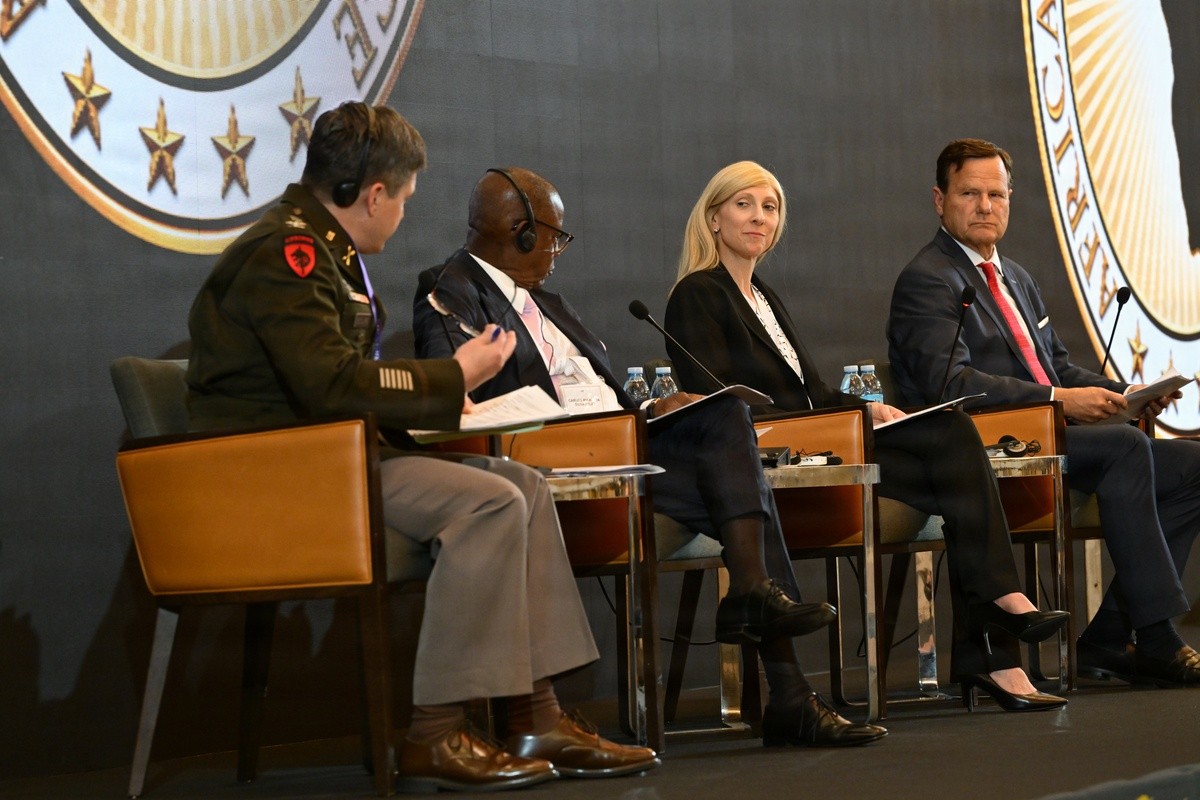
VIEW ORIGINAL2 / 5Show Caption +Hide Caption –U.S. Army Col. Sean McClure, military advisor Africa Center for Strategic Studies; Tanzania Army Gen. Jacob John Mkunda, chief of defence forces, Tanzania Peoples’ Defence Forces; Senegal Navy Vice Adm. Oumar Wade, chief of defence, Senegalese Armed Forces; Brazilian Adm. Renato Rodrigues de Aguiar Freire, chief of the Joint Staff of the Brazilian Armed Forces; and U.S. Army Brig. Gen. Eero Keravuori, deputy director of plans and strategic integration, U.S. Africa Command, participate in a panel discussing new dynamics on shifting security demands during the 2026 African Chiefs of Defense (ACHOD) Conference in Luanda, Angola June 30, 2026. ACHOD 2026 brought together senior military leaders from across Africa and partner nations to strengthen strategic relationships, address shared security challenges, and advance regional cooperation.
Chiefs of Defense and representatives from more than 35 countries as well as U.S. and partner military leaders, gather in Luanda, Angola, for the 2026 African Chiefs of Defense Conference. ACHOD serves as the key forum for senior military officials to address shared security threats, enhance regional stability, and discuss collaborative frameworks that enable long-term investment and economic growth across the continent. (U.S. Army photo by Staff Sgt. Raquel Birk) (Photo Credit: Staff Sgt. Raquel Birk)
From the left, Royal Air Force Col. Maj. Abdellah Athmani, chief of the 2nd Bureau, Royal Moroccan Armed Forces; U.S. Army Maj. Gen. John R. Pippy, Adjutant General of Pennsylvania; Nathan Nwachuku, physicist and techno-industrialist, co-founder of Terra Industries, and U.S. Air Force Brig. Gen. Paul G. Filcek, commander, 82nd Training Wing and installation commander, Sheppard Air Force, Texas, participate in a panel discussing innovation solutions during the 2026 African Chiefs of Defense Conference in Luanda, Angola July 1, 2026. The panel brought together military and industry leaders to discuss emerging technologies, strengthen collaborative approaches to innovation, and identify solutions to shared security challenges across Africa. (U.S. Army photo by Staff Sgt. Raquel Birk) (Photo Credit: Staff Sgt. Raquel Birk)
VIEW ORIGINAL4 / 5Show Caption +Hide Caption –Senior military leaders from across Africa and partner nations attend the 2026 African Chiefs of Defense Conference to strengthen strategic relationships, address shared security challenges, and advance regional cooperation. (U.S. Army photo by Takisha Hall) (Photo Credit: Takisha Hall)VIEW ORIGINAL5 / 5Show Caption +Hide Caption –From the left, U.S. Army Col. Sean McClure, military advisor, Africa Center for Strategic Studies; Dr. Carlos Maria Da Silva Feijo, legal scholar, practitioner, and former statesman; Bethany Aquilina Brez, vice president of the Office of Foreign Policy at the U.S. International Development Finance Corporation; Mark Mitchell, deputy assistant secretary for the Office of Middle East and Africa at the International Trade Administration, participate in a panel discussing economic opportunity, linking stability and prosperity during the 2026 Chiefs of Defense Conference in Luanda, Angola June 30, 2026. Experts emphasized how financial prosperity and regional security are deeply intertwined. The session highlighted that building stable, resilient economies is a vital defense strategy for preventing conflict and securing long-term growth across the continent. (U.S. Army photo by Staff Sgt. Raquel Birk) (Photo Credit: Staff Sgt. Raquel Birk)VIEW ORIGINAL
The 2026 African Chiefs of Defense Conference (ACHOD), hosted in Angola, reinforced the growing partnerships between military, civilian and industry.
The conference theme, “Leveraging our strengths – advancing regional security for enduring prosperity,” offered participants the opportunity to consider a comprehensive approach to security on the African continent through a series of forums addressing topics ranging from cross-border security and integrating commercial innovation to engaging in the information domain.
“This year’s conference demonstrated the uniqueness of the U.S. partnership model, which is focused on increasing partners’ capabilities while respecting their sovereignty and maintaining our commitment to mutual prosperity,” said
U.S. Army Brig. Gen. Eero R. Keravuori, deputy director, Strategy, Engagement and Programs, U.S. Africa Command and the U.S. master of ceremonies for the conference. “The African nations who attended this year’s conference are capable and willing partners committed to addressing our shared threats and understand that security leads to stability which is required for prosperity.”
Military leaders, government and industry representatives as well as security experts from across the African continent and United States came together, reinforcing the AFRICOM commitment to a holistic, transparent, and mutually beneficial partnership model.
The conference featured four targeted panels designed to address the multifaceted challenges and opportunities facing the African continent:
Global Commons – Crossing the Seams: Addressing cross-border security and shared maritime and airspace domains
Information Domain – Owning the Story: Countering misinformation and building transparent communication networks.
Economic Opportunity – Linking Stability and Prosperity: Connecting defense economics, direct investment, and long-term stability.
Innovating Solutions – Beyond Technology in Operations: Integrating commercial innovation and non-traditional alliances.
The significance of the 2026 ACHOD conference was clearly recognized by senior U.S. Department of War leadership.
African Chiefs of Defense discuss information domain cooperation at ACHOD 2026
From the left, U.S. Air Force Gen. Dagvin R. Anderson, commander of U.S. Africa Command; Gen. Olufemi Olatubosun Oluyede, chief of Defence, Staff of the Nigerian Armed Forces; U.S. Navy Rear Adm. Cameron Chen, deputy director, USAFRICOM J3; U.S. Air Force Col. Rebecca Heyse, director, USAFRICOM Public Affairs; and Vice Air Marshall Francis Ogbejele Edosa, chief of Defence Policy and Plans, participate in an information domain panel during the 2026 Chiefs of Defense Conference (ACHOD) in Luanda Angola June 30, 2026. The panel brought together senior military leaders to discuss the role of the information domain in strengthening strategic communication, countering malign influence, and enhancing multinational cooperation across Africa.
(U.S. Army photo by Staff Sgt. Raquel Birk) (Photo Credit: Staff Sgt. Raquel Birk)
Secretary of War Pete Hegseth as well as the U.S. Chairman of the Joint Chiefs of StaffGen. Dan Caine, and U.S. Vice Chairman of the Joint Chiefs of Staff, Gen. Christopher Mahoney each took time to provide remarks virtually from Washington, D.C., reaffirming commitment from the most senior level of the Pentagon to work towards solutions to shared security threats with African partners.
In addition to the panel discussions and keynotes, this year’s conference featured an inaugural industry roundtable.
U.S. Army Brig. Gen. Eero Keravuori, deputy director of plans and strategic integration, U.S. Africa Command, shares remarks during the Industry Round Table. (Photo Credit: Staff Sgt. Raquel Birk)VIEW ORIGINAL
“The primary objective of the roundtable was to gather direct feedback from private industry regarding the roadblocks to operating in Africa,” said Keravuori. “The roundtable offered opportunities for professional exchanges between senior commercial and private principals while identifying potential solutions to complex business issues.”
The discussions in Luanda reaffirmed that by sharing unique capabilities, driving innovation, and integrating economic initiatives with security operations, AFRICOM and its African partners are building a stronger, more secure future together.
“Your commitment throughout this event is the reason for its success,” said Angolan Aviation General Altino dos Santos, Chief of the General Staff of the Angolan Armed Forces. “You have opened the channels of dialogue and discussion of the most pressing security issues and ways to support economic prosperity. The deep understanding we gained will enable our forces to advance our regional security, defend peace and ensure stability.”
Angola Chief of the General Staff Gen. Altino dos Santos shares closing ceremony remarks during the 2026 African Chiefs of Defense Conference (ACHOD) in Luanda, Angola, July 1, 2026. The closing ceremony marked the conclusion of ACHOD 2026, reinforcing participating nations’ commitment to strengthening military partnerships, advancing regional security cooperation, and addressing shared security challenges across Africa.
Chiefs of Defense and representatives from more than 35 countries as well as U.S. and partner military leaders gather for the 2026 African Chiefs of Defense Conference. ACHOD serves as the key forum for senior military officials to address shared security threats, enhance regional stability, and discuss collaborative frameworks that enable long-term investment and economic growth across the continent. (U.S. Army photo by Staff Sgt. Raquel Birk) (Photo Credit: Staff Sgt. Raquel Birk)
U.S. Africa Command, one of 11 U.S. Department of Defense combatant commands, has an area of responsibility covering 53 African states, more than 800 ethnic groups, over 1,000 languages, vast natural resources, a land mass that is three-and-a-half times the size of the U.S., and nearly 19,000 miles of coastland. Working alongside its partners, AFRICOM counters transnational threats and malign actors, strengthens security forces and responds to crises.
U.S. Army Southern European Task Force, Africa (SETAF-AF) prepares Army forces, executes crisis response, enables strategic competition and strengthens partners to achieve U.S. Army Europe and Africa and U.S. Africa Command campaign objectives.
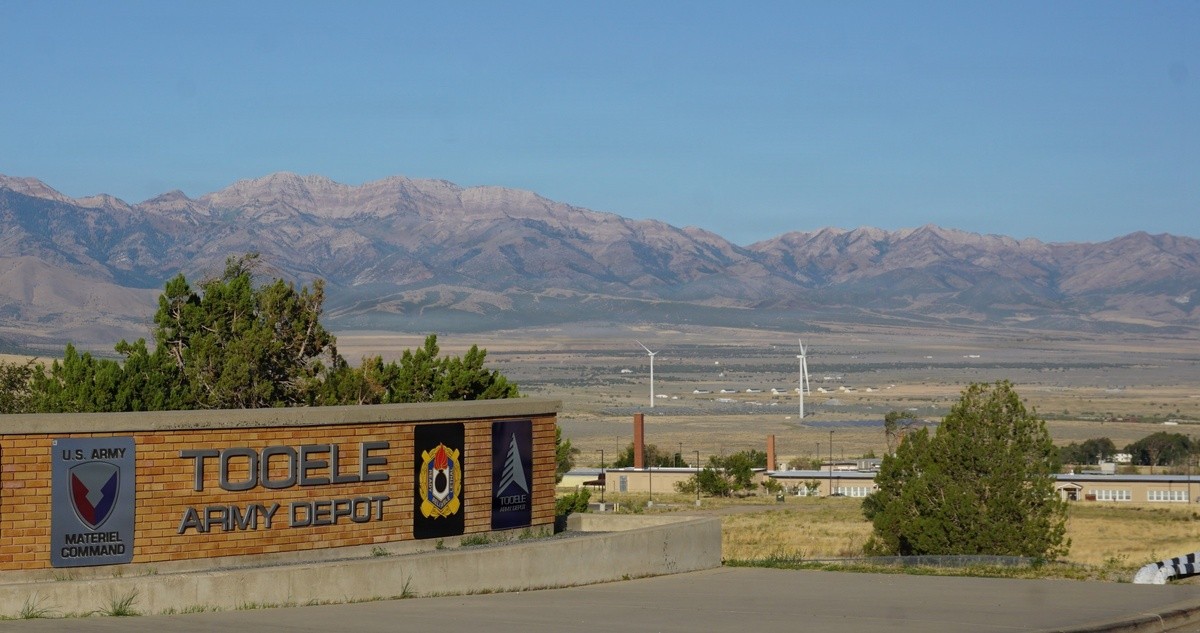
Joint Interagency Task Force 401 conducted training using the Bumblebee V2 system in coordination with the 75th Ranger Regiment to increase counter-unmanned aircraft system capabilities at Fort Benning, Georgia, July 8, 2026. JIATF-401 is rapidly delivering C-UAS capabilities to warfighters at home and abroad. (Photo Credit: U.S. Army photo by Lt. Col. Adam Scher)VIEW ORIGINAL
FORT BENNING, Ga. — Joint Interagency Task Force 401 and the 3rd Battalion, 75th Ranger Regiment, completed a comprehensive five-day operational training exercise July 6-10, 2026, at Fort Benning to evaluate and employ the Bumblebee V2 counter-drone system in defense of military installations and domestic critical infrastructure. This training represents the latest tactical integration of low-cost, low-collateral air-to-air interceptors designed to secure domestic airspace and installations from drone threats.
The training at Fort Benning marks a major step forward in transitioning cutting-edge, artificial intelligence-enabled drone technology into the hands of elite rapid-response warfighters. Developed under an initial $5.2 million agreement in early 2026 and scaled under a landmark three-year, $500 million contract awarded in May 2026, the Bumblebee V2 is a next-generation, first-person-view multi-rotor drone designed specifically to hunt and neutralize hostile small unmanned aircraft systems.
“Our Rangers train to deploy rapidly and operate under the most challenging, high-stakes conditions in the world,” said Lt. Col. Jon Peterson, commander of the 3rd Battalion, 75th Ranger Regiment. “The Ranger Regiment has a long history of pioneering the integration of advanced technologies and operational concepts that can then be rapidly proliferated across the Army and the joint force. Developing top-tier counter-UAS is a priority that requires our immediate action.”
Lt. Co. Alex Morse, assistant acquisitions director for Joint Interagency Task Force 401, briefs reporters during a counter-unmanned aircraft systems demonstration at Fort Benning, Georgia, July 8, 2026. JIATF-401 conducted training using the Bumblebee V2 system in coordination with the 75th Ranger Regiment to increase C-UAS capabilities. (Photo Credit: U.S. Army photo by Lt. Col. Adam Scher)VIEW ORIGINAL
Unlike traditional battlefield kinetic effectors that utilize energetic or explosive payloads, the Bumblebee V2 operates via a pure physical-collision mechanism. The system uses high-speed, direct kinetic energy upon physical contact to render both the interceptor and the threat inoperable, providing a safe, low-collateral solution. This precision-impact capability is optimized for domestic homeland defense under Title 10, Section 130i provisions, allowing commanders to protect critical military installations and national infrastructure without risking lives or property on the ground.
The Bumblebee V2 features an advanced three-camera array with improved gimbal rotation and artificial intelligence-driven automated target recognition. This feature reduces the cognitive load on operators, allowing soldiers to maintain full situational awareness while the drone autonomously tracks and executes hard-kill intercepts in mid-air.
“Securing our domestic airspaces and safeguarding critical infrastructure is both a modern battlefield reality and a vital homeland defense imperative,” said Army Brig. Gen. Matthew Ross, director of JIATF-401. “The Bumblebee V2 gives installation commanders a cost-effective, reliable interceptor that can neutralize threats without endangering our own forces or surrounding infrastructure. As the threat of drones continues to evolve, having a low-collateral kinetic option is essential for homeland defense.”
As part of the evaluation event, JIATF-401 assessed a UAS target management capability from DRACOE. Based in North Carolina, DRACOE is a veteran-owned and operated business providing low-cost UAS components paired with a flight software management system that automates representative targets for counter-UAS training. Reducing the training cost and time is a pivotal aspect of JIATF-401’s approach to delivering state-of-the-art counter-UAS capability to warfighters.
By partnering with the 3rd Battalion, 75th Ranger Regiment, JIATF-401 leverages a formation uniquely suited to rapidly evaluate emerging technologies under realistic operational conditions. The Ranger Regiment’s ability to integrate, refine and validate new capabilities helps accelerate the transition of promising technologies into operational use across the Army and the broader joint force. Through this collaboration, JIATF-401 continues to systematically expand the joint force’s capacity to employ layered, non-explosive kinetic defenses against evolving drone threats at home and abroad.
U.S. Army Maj. Gen. Matthew S. Woodruff, right, adjutant general for the State of Ohio, and Angolan Aviation Gen. Altino Carlos José dos Santos, left, chief of the General Staff of the Angolan Armed Forces, sign a State Partnership Program agreement ahead of the 2026 African Chiefs of Defense Conference in Luanda, Angola, June 29, 2026. The agreement formalized the Ohio National Guard’s partnership with Angola, establishing a long-term framework for military cooperation, leadership development and institutional collaboration in support of regional security and stability.
Chiefs of defense and representatives from more than 35 countries, as well as U.S. and partner military leaders, gathered for the 2026 African Chiefs of Defense Conference. ACHOD serves as the key forum for senior military officials to address shared security threats, enhance regional stability and discuss collaborative frameworks that enable long-term investment and economic growth across the continent. (U.S. Army photo by Sgt. 1st Class Thomas Moegar) (Photo Credit: Sgt. 1st Class Thomas Moeger)
Senior military leaders from the Republic of Angola, the Ohio National Guard and U.S. Africa Command opened a new chapter in U.S.-Africa security cooperation during the State Partnership Program Adjutants General Conference and formal partnership signing ceremony, June 29, prior to the 2026 African Chiefs of Defense Conference.
The conference brought together National Guard adjutants general and representatives from 10 U.S. states, African military leaders and U.S. Africa Command officials to align the SPP with broader theater security objectives before ACHOD officially began. Throughout the day, leaders discussed expanding military cooperation, strengthening partner capacity and building enduring relationships that support regional stability.
U.S. Army Maj. Gen. Matthew S. Woodruff, right, adjutant general for the Ohio National Guard, and Angolan Aviation Gen. Altino Carlos José dos Santos, left, chief of the General Staff of the Angolan Armed Forces, sign a State Partnership Program agreement prior to the 2026 African Chiefs of Defense Conference in Luanda, Angola, June 29, 2026. The agreement formalized the Ohio National Guard’s partnership with Angola, establishing a long-term framework for military cooperation, leadership development and institutional collaboration in support of regional security and stability.
Chiefs of defense and representatives from more than 35 countries, as well as U.S. and partner military leaders, gathered for the 2026 African Chiefs of Defense Conference. ACHOD serves as the key forum for senior military officials to address shared security threats, enhance regional stability and discuss collaborative frameworks that enable long-term investment and economic growth across the continent. (U.S. Army photo by Sgt. 1st Class Thomas Moegar) (Photo Credit: Sgt. 1st Class Thomas Moeger)
“This is more than a ceremony, it is a commitment,” said Shannon Nagy Cazeau, chargé d’affaires of the U.S. Embassy in Luanda. “A commitment between two peoples, two militaries and two nations to build something lasting together.”
The agreement, signed by U.S. Army Maj. Gen. Matthew S. Woodruff, adjutant general for the State of Ohio, and Angolan Aviation Gen. Altino Carlos José dos Santos, chief of the General Staff of the Angolan Armed Forces, reaffirmed the Ohio National Guard’s partnership with Angola and established a framework for decades of sustained military, governmental and institutional collaboration. The ceremony also established priorities for future cooperation in professional military education, leadership development, disaster response, medical readiness, cyber capabilities and joint planning.
Military leaders from the Republic of Angola, the Ohio National Guard and U.S. Africa Command gather for a State Partnership Program signing ceremony held June 29, 2026, alongside the 2026 African Chiefs of Defense Conference.
The agreement formalized the Ohio National Guard’s partnership with Angola, establishing a long-term framework for military cooperation, leadership development and institutional collaboration in support of regional security and stability.
Chiefs of defense and representatives from more than 35 countries, as well as U.S. and partner military leaders, gathered for the 2026 African Chiefs of Defense Conference. ACHOD serves as the key forum for senior military officials to address shared security threats, enhance regional stability and discuss collaborative frameworks that enable long-term investment and economic growth across the continent. (U.S. Army photo by Sgt. 1st Class Thomas Moegar) (Photo Credit: Sgt. 1st Class Thomas Moeger)
“This is a historic day,” Woodruff said. “Ohio has maintained successful State Partnership Program relationships for more than three decades, and we are honored to begin this journey with Angola. Together we will exchange techniques, tactics and procedures, grow our capabilities and build relationships that will endure for generations.”
The partnership builds upon years of growing cooperation between the United States and Angola while laying the foundation for sustained institutional relationships that extend well beyond traditional military engagements. Rather than focusing on one-time events, both nations committed to recurring exchanges designed to strengthen readiness and develop long-term interoperability.
U.S. Air Force Gen. Dagvin Anderson, commander of U.S. Africa Command, and adjutants generals participate in the State Partnership Program Adjutants General Conference ahead of the 2026 African Chiefs of Defense Conference in Luanda, Angola, June 29, 2026. The conference brought together National Guard adjutants general and USAFRICOM leaders to strengthen State Partnership Program relationships, align theater security cooperation priorities and expand long-term collaboration across the continent.
Chiefs of defense and representatives from more than 35 countries, as well as U.S. and partner military leaders, gathered for the 2026 African Chiefs of Defense Conference. ACHOD serves as the key forum for senior military officials to address shared security threats, enhance regional stability and discuss collaborative frameworks that enable long-term investment and economic growth across the continent. (Photo by Jason Johnston) (Photo Credit: Jason Johnston)
“Relationships lead to trust, and trust leads to meaningful cooperation,” Woodruff said. “Every engagement must build capacity for both organizations so that each exchange is mutually beneficial.”
The SPP, administered by the National Guard Bureau on behalf of the Office of the Secretary of War and executed by state National Guards in support of U.S. geographic combatant commands, has connected U.S. states with partner nations since 1993. Today, more than 100 partnerships strengthen military readiness while fostering cooperation across government, industry and civil society.
“That’s where a state partnership pays huge dividends because of that consistency over years to build a relationship and develop something deliberately,” said U.S. Air Force Gen. Dagvin R. Anderson, commander of USAFRICOM. “Nobody else brings this. This is a unique capability that is purely American.”
Military leaders from the Republic of Angola, the Ohio National Guard and U.S. Africa Command gather for a group photo during a State Partnership Program signing ceremony held June 29, 2026, alongside the 2026 African Chiefs of Defense Conference.
The agreement formalized the Ohio National Guard’s partnership with Angola, establishing a long-term framework for military cooperation, leadership development and institutional collaboration in support of regional security and stability.
Chiefs of defense and representatives from more than 35 countries, as well as U.S. and partner military leaders, gathered for the 2026 African Chiefs of Defense Conference. ACHOD serves as the key forum for senior military officials to address shared security threats, enhance regional stability and discuss collaborative frameworks that enable long-term investment and economic growth across the continent. (U.S. Army photo by Sgt. 1st Class Thomas Moegar) (Photo Credit: Sgt. 1st Class Thomas Moeger)
Holding the SPP Adjutants General Conference immediately before ACHOD allowed National Guard leaders and African chiefs of defense to synchronize priorities before broader discussions on regional security began. Organizers said integrating the two events reinforced how state-level partnerships support theater objectives while complementing strategic engagement across the continent.
“It ensures our state leaders understand the combatant commander’s priorities and can reinforce those priorities directly with their counterparts,” said U.S. Army Col. Anthony Passero, a senior National Guard advisor for USAFRICOM. “At the same time, every engagement increases readiness for both the partner nation and the National Guard unit.”
The Angola-Ohio partnership officially began in August 2025 when Angola became Ohio’s third State Partnership Program partner, joining Hungary, partnered since 1993, and Serbia, partnered since 2006. A letter of intent signed in Columbus, Ohio, in April 2026 established the governmental framework for cooperation, while the June 29 ceremony formally activated the military component of that agreement.
U.S. Air Force Gen. Dagvin Anderson, commander of U.S. Africa Command, and adjutants general participate in the State Partnership Program Adjutants General Conference prior to the 2026 Africa Chiefs of Defense Conference in Luanda, Angola June 29, 2026. The conference brought together National Guard adjutants general and USAFRICOM leaders to strengthen State Partnership Program relationships, align theater security cooperation priorities and expand long-term collaboration across the continent.
Chiefs of defense and representatives from more than 35 countries, as well as U.S. and partner military leaders, gathered for the 2026 African Chiefs of Defense Conference. ACHOD serves as the key forum for senior military officials to address shared security threats, enhance regional stability and discuss collaborative frameworks that enable long-term investment and economic growth across the continent. (Photo by Jason Johnston) (Photo Credit: Jason Johnston)
“This represents not only the strengthening of bilateral cooperation but the activation of a shared vision for security, stability and development,” said retired Angolan army Gen. Lucio Gonçalves Amaral, head of Angola’s Ministry of National Defense, Former Combatants and Veterans of the Homeland. “Military-to-military cooperation remains at the heart of this partnership through personnel exchanges, operational experience, joint training and professional development.”
Angolan leaders said the partnership extends beyond defense cooperation, to include creating opportunities for collaboration between military and civilian institutions in emergency management, healthcare, infrastructure protection, education and economic development, while strengthening regional resilience.
“What makes this program unique is the National Guard’s dual civilian-military identity,” Cazeau said. “Ohio’s citizen-Soldiers and Airmen bring not only military expertise, but also the experience of professionals who serve their communities every day as doctors, engineers, emergency responders and educators.”
State Partnership Program Adjutants General Conference attendees pose for a group photo with U.S. Air Force Gen. Dagvin Anderson, commander of U.S. Africa Command, ahead of the 2026 African Chiefs of Defense Conference in Luanda, Angola June 29, 2026. The conference brought together National Guard adjutants general and USAFRICOM leaders to strengthen State Partnership Program relationships, align theater security cooperation priorities and expand long-term collaboration across the continent.
Chiefs of defense and representatives from more than 35 countries, as well as U.S. and partner military leaders, gathered for the 2026 African Chiefs of Defense Conference. ACHOD serves as the key forum for senior military officials to address shared security threats, enhance regional stability and discuss collaborative frameworks that enable long-term investment and economic growth across the continent. (Photo by Jason Johnston) (Photo Credit: Jason Johnston)
As the SPP Adjutants General Conference concluded and ACHOD 2026 began, leaders committed to developing an annual engagement plan to guide future exchanges between the Ohio National Guard and the Angolan Armed Forces through professional military education, medical and cyber collaboration, disaster preparedness initiatives and senior leader engagements.
“The State Partnership Program opens the door for everything good that follows U.S. military engagement,” Passero said. “It strengthens military-to-military relationships while creating opportunities for cultural exchange, industry engagement and foreign military sales that benefit both partners.”
About SETAF-AF
U.S. Army Southern European Task Force, Africa (SETAF-AF) prepares Army forces, executes crisis response, enables strategic competition and strengthens partners to achieve U.S. Army Europe and Africa and U.S. Africa Command campaign objectives.
Tape measures lie on a table at an Army Body Composition Program (ABCP) Circumference Methodology course hosted by Holistic Health and Fitness at Fort Jackson, South Carolina. (Photo Credit: U.S. Army photo by Sgt. 1st Class Crystal Harlow)VIEW ORIGINAL
WASHINGTON — The Army has replaced the long-standing height and weight tables, circumference-based tape test, and supplemental body fat assessments with the Waist-to-Height Ratio (WHtR) health assessment tool. This immediate change is part of a broader effort to accurately assess soldier health, increase force readiness, and continue to align the Army Body Composition Program with medically validated practices.
“This is about lethality and health,” said Sgt. Maj. Monsanto, Deputy Chief of Staff, G-1, Directorate of Prevention, Resilience, Readiness. “We are adopting new metrics to ensure our soldiers are healthy and physically fit to fight and win.”
Under the new policy, all soldiers will undergo a WHtR assessment twice per calendar year. A waist to height ratio of less than 0.55 is the new benchmark for compliance. The implementation of this assessment measures a soldier’s waistline at the navel (belly button) and divides that measurement by their height in inches, which produces the ratio for record. The Army will conduct a 180-day assessment of the new WHtR to validate accuracy and determine if adjustments are needed.
U.S. Army graphic outlining the Army’s update to its Body Composition Program and describes the new Waist-to-Height Ratio (WHtR) standard, Pentagon, Washington, D.C., July 7, 2026. (Photo Credit: U.S. Army graphic by Staff Sgt. Alexander Nieves)VIEW ORIGINAL
Soldiers whose WHtR is 0.55 or greater will receive a confirmation test by another team on the same duty day to verify accuracy. If a soldier fails the WHtR assessment, placement in the Army Body Composition program will follow to begin the process for compliance.
“Our human resource continuous transformation initiative requires that we modernize how we improve readiness and our warfighting lethality,” said Sgt. Maj. Monsanto. “By incorporating the Waist-to-Height Ratio, we are becoming more adaptive and agile, ensuring our soldiers are healthy and physically fit to fight and win.”
The Army will continue to use a formal flagging action for soldiers whose Waist-to-Height Ratio is 0.55 or higher. Under the updated policy, these soldiers are flagged and enrolled in the Army Body Composition Program until they meet the standard. No separation actions for failing WHtR will occur during the Army’s initial 180‑day assessment period.
To ensure standards of professionalism remain consistent across the Army, commanders at any time may direct a soldier to undergo a WHtR assessment if they are concerned that the soldier does not meet the WHtR standard.
This transition to the Waist-to-Height Ratio marks a significant step in modernizing the Army’s approach to health and fitness. By adopting an accurate and medically validated standard, we are ensuring our soldiers are prepared for the demands of the modern battlefield and fostering a healthier, more lethal force.
U.S. Air Force Brig. Gen. Mitchell Johnson, second from the right, the adjutant general for the North Dakota National Guard and director of the North Dakota Department of Emergency Services, speaks with the military member of Togo’s National Civil Protection Agency, left, during a visit to a field operations center at the field exercise portion of Operation Lignite Coast 2026 in Agome-Glozou, Togo, June 15, 2026. U.S. Army Capt. Euston Harp, team chief for Civil Affairs Team Togo, Alpha Company, Civil Affairs Battalion, U.S. Army Southern European Task Force, Africa (SETAF-AF) stands on the right.
Operation Lignite Coast 2026 was a training event conducted June 8-18, 2026, in various locations in Togo, focused on improving the Togolese government’s capacity to handle a variety of emergency scenarios. It culminated in a three-day field exercise that provided the NCPA’s civilian and military personnel with practical application of training concepts they previously learned in emergency response. Planning Lignite Coast began in December 2025 and involved significant collaboration with the North Dakota National Guard, Togo’s state partner through the National Guard’s State Partnership Program. (U.S. Army photo by Sgt. 1st Class Shane Klestinski) (Photo Credit: Sgt. 1st Class Shane Klestinski)
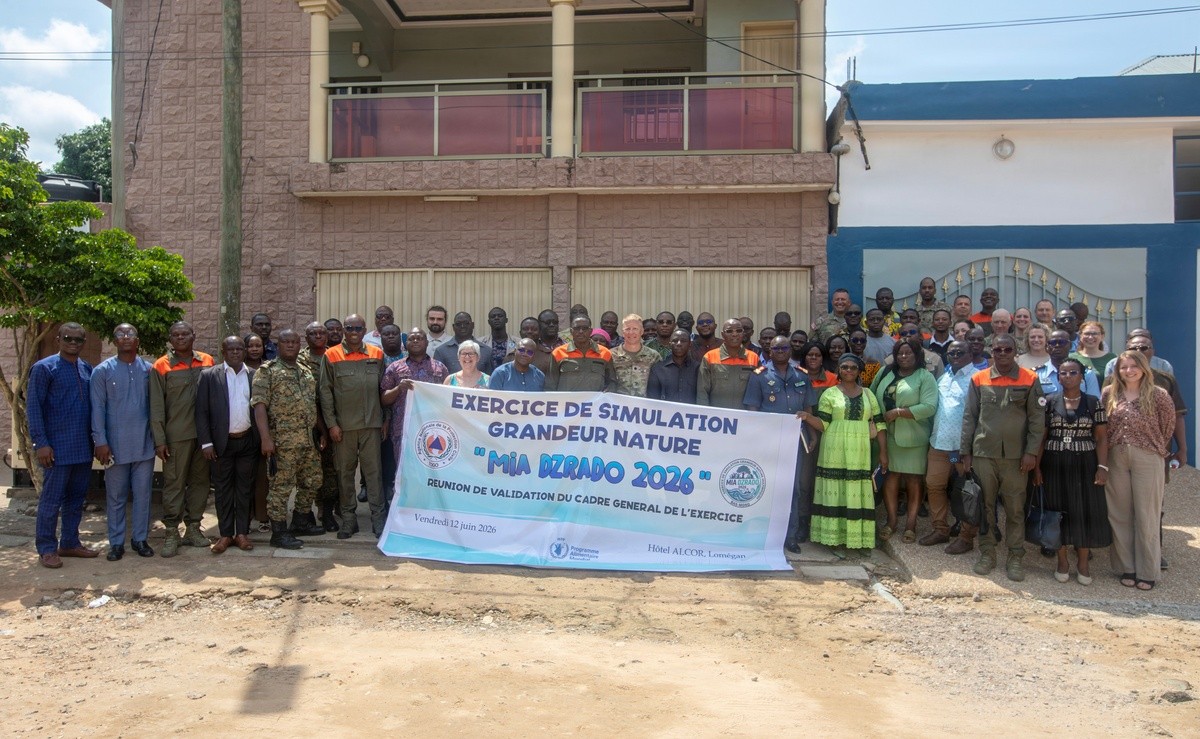
Togo’s National Civil Protection Agency conducted a field training exercise with North Dakota disaster-relief experts and civil affairs Soldiers assigned to U.S. Army Southern European Task Force, Africa (SETAF-AF) in Agome-Glozou, Togo, June 15-17.
The three-day activity focused on incident response and disaster preparedness. It was the culminating event for Operation Lignite Coast 2026, the overall training exercise that took place June 8-18, which sought to improve the NCPA’s capacity to handle a variety of emergency situations.
From left: Togolese Lt. Col. Yoma Baka, director general for the National Civil Protection Agency; Sogbo Kokou Amétépé, prefect of the Bas-Mono Prefecture; U.S. Army Lt. Col. Al Roehrich, Operation Lignite Coast 2026 lead planner for the North Dakota National Guard and deputy director of the North Dakota Domestic Operations Branch, attend the opening ceremony for Lignite Coast’s field exercise in the Bas-Mono Prefecture, Togo, June 15, 2026.
Operation Lignite Coast 2026 was a training event conducted June 8-18, 2026, in various locations in Togo, focused on improving the Togolese government’s capacity to handle a variety of emergency scenarios. It culminated in a three-day field exercise that provided the NCPA’s civilian and military personnel with practical application of training concepts they previously learned in emergency response. Planning Lignite Coast began in December 2025 and involved significant collaboration with the North Dakota National Guard, Togo’s state partner through the National Guard’s State Partnership Program. (U.S. Army photo by Sgt. 1st Class Shane Klestinski) (Photo Credit: Sgt. 1st Class Shane Klestinski)
“One of the hardest things for civilian and military agencies to do is get together in a whole-of-government approach,” said U.S. Army Lt. Col. Al Roehrich, Lignite Coast lead planner for the North Dakota National Guard and deputy director of the North Dakota Domestic Operations Branch. “This venue allows us, whether it’s the fire department, the military, the police [or other organizations] to come together in a setting that would happen in a real-world scenario.”
Sherry Adams, left, North Dakota state health officer and Southwestern District Health Unit executive officer, and U.S. Army Lt. Col. Mandy Iverson, second from the left, a plans officer with the North Dakota National Guard Domestic Operations Branch, pause to pose with members of Togo’s National Civil Protection Agency at a local medical treatment facility in Agome-Glozou, Togo, June 15, 2026. They are donating medical supplies, specifically syringes and surgical gloves, as well as sunglasses for patients recovering from recent cataract surgery.
This visit coincided with Operation Lignite Coast 2026, a training event conducted June 8-18, 2026, in various locations in Togo, focused on improving the Togolese government’s capacity to handle a variety of emergency scenarios. It culminated in a three-day field exercise that provided the NCPA’s civilian and military personnel with practical application of training concepts they previously learned in emergency response. Planning Lignite Coast began in December 2025 and involved significant collaboration with the North Dakota National Guard, Togo’s state partner through the National Guard’s State Partnership Program. (U.S. Army photo by Sgt. 1st Class Shane Klestinski) (Photo Credit: Sgt. 1st Class Shane Klestinski)
U.S. Air Force Brig. Gen. Mitchell Johnson, the adjutant general for the North Dakota National Guard and director of the North Dakota Department of Emergency Services, toured the training area and spoke with several NPCA officials engaged in the practical exercise. Johnson also visited a local hospital on the exercise’s first day when the North Dakota delegation donated medical supplies, specifically syringes and surgical gloves, as well as sunglasses for patients recovering from recent cataract surgery.
Togo and the North Dakota National Guard have been partners through the National Guard’s State Partnership Program for over 12 years. This relationship allows North Dakota’s emergency-response officials to work with the NCPA (Togo’s equivalent of the Federal Emergency Management Agency) to replicate real-world scenarios for training purposes. Like North Dakota’s emergency-response community, the NCPA is a mixture of civilian and military personnel.
1 / 2Show Caption +Hide Caption –Law enforcement, military and civilian members of Togo’s National Civil Protection Agency simulate setting up a physical security perimeter for approximately 180 local villagers, not pictured, who are roleplaying as displaced persons during a field training exercise simulating the aftermath of a flood in Agome-Glozou, Togo, June 15, 2026.
Operation Lignite Coast 2026 was a training event conducted June 8-18, 2026, in various locations in Togo, focused on improving the Togolese government’s capacity to handle a variety of emergency scenarios. It culminated in a three-day field exercise that provided the NCPA’s civilian and military personnel with practical application of training concepts they previously learned in emergency response. Planning Lignite Coast began in December 2025 and involved significant collaboration with the North Dakota National Guard, Togo’s state partner through the National Guard’s State Partnership Program. (U.S. Army photo by Sgt. 1st Class Shane Klestinski) (Photo Credit: Sgt. 1st Class Shane Klestinski)
VIEW ORIGINAL2 / 2Show Caption +Hide Caption –Law enforcement, military and civilian members of Togo’s National Civil Protection Agency, right, simulate setting up a physical security perimeter for approximately 180 local villagers, left, who are roleplaying as displaced persons during a field training exercise simulating the aftermath of a flood in Agome-Glozou, Togo, June 15, 2026.
Operation Lignite Coast 2026 was a training event conducted June 8-18, 2026, in various locations in Togo, focused on improving the Togolese government’s capacity to handle a variety of emergency scenarios. It culminated in a three-day field exercise that provided the NCPA’s civilian and military personnel with practical application of training concepts they previously learned in emergency response. Planning Lignite Coast began in December 2025 and involved significant collaboration with the North Dakota National Guard, Togo’s state partner through the National Guard’s State Partnership Program. (U.S. Army photo by Sgt. 1st Class Shane Klestinski) (Photo Credit: Sgt. 1st Class Shane Klestinski)
“The more you practice with all the players together, the better it will be when a real-life event happens,” Roehrich said.
NCPA participants responded to various training situations, such as an incident involving multiple, large-capacity canoes capsizing, a major traffic accident on a bridge, and a displaced-persons scenario following a flood — which also subsequently caused a notional malaria outbreak — among others.
A member of Togo’s National Civil Protection Agency, left, speaks with U.S. Air Force Brig. Gen. Mitchell Johnson, right, the adjutant general for the North Dakota National Guard and director of the North Dakota Department of Emergency Services, at a visit to the field operations center during the field exercise portion of Operation Lignite Coast 2026 in Agome-Glozou, Togo, June 15, 2026. In the center is U.S. Army Lt. Col. Al Roehrich, Lignite Coast lead planner for the North Dakota National Guard and deputy director of the North Dakota Domestic Operations Branch.
Operation Lignite Coast 2026 was a training event conducted June 8-18, 2026, in various locations in Togo, focused on improving the Togolese government’s capacity to handle a variety of emergency scenarios. It culminated in a three-day field exercise that provided the NCPA’s civilian and military personnel with practical application of training concepts they previously learned in emergency response. Planning Lignite Coast began in December 2025 and involved significant collaboration with the North Dakota National Guard, Togo’s state partner through the National Guard’s State Partnership Program. (U.S. Army photo by Sgt. 1st Class Shane Klestinski) (Photo Credit: Sgt. 1st Class Shane Klestinski)
“Collaborating to build those kinds of relationships were among the exercise’s operational goals and objectives — ‘engaging stakeholders’ — and we’re happy it’s happening,” said U.S. Army Lt. Col. Mandy Iverson, a plans officer with the North Dakota National Guard Domestic Operations Branch.
Iverson added that the incident-response training the Togolese completed was very similar to the training the North Dakota National Guard normally conducts.
“We’re here to help facilitate and foster an environment of continued relationship building, and the Lignite Coast mission makes that possible,” Iverson said. “This event brings together government, community members and NGOs working on disaster response. Multiple NGOs came to the event and worked with different sections or clusters, some of them for the first time.”
While emergencies requiring a comprehensive, government response can happen almost anywhere, the nature of those emergencies can be unpredictable. The agencies and skill sets necessary for an effective response, from both the military and civilian sides of the spectrum, can vary depending on the situation.
Richard Obilale, left, a translator, tells the English version of what a member of Togo’s National Civil Protection Agency just told U.S. Air Force Brig. Gen. Mitchell Johnson, right, the adjutant general for the North Dakota National Guard and director of the North Dakota Department of Emergency Services, during a visit to the field operations center during the field exercise portion of Operation Lignite Coast 2026 in Agome-Glozou, Togo, June 15, 2026.
Operation Lignite Coast 2026 was a training event conducted June 8-18, 2026, in various locations in Togo, focused on improving the Togolese government’s capacity to handle a variety of emergency scenarios. It culminated in a three-day field exercise that provided the NCPA’s civilian and military personnel with practical application of training concepts they previously learned in emergency response. Planning Lignite Coast began in December 2025 and involved significant collaboration with the North Dakota National Guard, Togo’s state partner through the National Guard’s State Partnership Program. (U.S. Army photo by Sgt. 1st Class Shane Klestinski) (Photo Credit: Sgt. 1st Class Shane Klestinski)
“Civil affairs Soldiers specialize in a multitude of areas – humanitarian aid, disaster response, civil-military integration and civil-military coordination,” said U.S. Army Capt. Euston Harp, team chief for Civil Affairs Team Togo, Alpha Company, Civil Affairs Battalion, SETAF-AF. “Those aspects are important during these types of exercises and in real-world events.”
Prior to the field exercise, CA Team Togo conducted a subject matter expert exchange with NCPA personnel to assess and evaluate their ability to apply civil affairs in a real-world training scenario. This exchange not only highlighted the significance of civil-military integration in a disaster response, it also underscored the benefits his team received in improved readiness.
“Lignite Coast is a great opportunity for us to get some training reps to improve our own posture when it comes to humanitarian aid and disaster response,” Harp said. “Training exercises like these allow us to approach [our work] from a different angle, and they demonstrate our commitment to partners and allies.”
1 / 4Show Caption +Hide Caption –Administrative staff members of Togo’s National Civil Protection Agency process approximately 180 local villagers who are roleplaying as displaced persons during a field training exercise simulating the aftermath of a flood in Agome-Glozou, Togo, June 15, 2026.
Operation Lignite Coast 2026 was a training event conducted June 8-18, 2026, in various locations in Togo, focused on improving the Togolese government’s capacity to handle a variety of emergency scenarios. It culminated in a three-day field exercise that provided the NCPA’s civilian and military personnel with practical application of training concepts they previously learned in emergency response. Planning Lignite Coast began in December 2025 and involved significant collaboration with the North Dakota National Guard, Togo’s state partner through the National Guard’s State Partnership Program. (U.S. Army photo by Sgt. 1st Class Shane Klestinski) (Photo Credit: Sgt. 1st Class Shane Klestinski)
VIEW ORIGINAL2 / 4Show Caption +Hide Caption –Civilian members of Togo’s National Civil Protection Agency inflate temporary housing modules to shelter approximately 180 local villagers, in the background on the right, who are roleplaying as displaced persons during a field training exercise simulating the aftermath of a flood in Agome-Glozou, Togo, June 15, 2026.
Operation Lignite Coast 2026 was a training event conducted June 8-18, 2026, in various locations in Togo, focused on improving the Togolese government’s capacity to handle a variety of emergency scenarios. It culminated in a three-day field exercise that provided the NCPA’s civilian and military personnel with practical application of training concepts they previously learned in emergency response. Planning Lignite Coast began in December 2025 and involved significant collaboration with the North Dakota National Guard, Togo’s state partner through the National Guard’s State Partnership Program. (U.S. Army photo by Sgt. 1st Class Shane Klestinski) (Photo Credit: Sgt. 1st Class Shane Klestinski)
VIEW ORIGINAL3 / 4Show Caption +Hide Caption –Law enforcement and military members of Togo’s National Civil Protection Agency, foreground, provide an improvised security perimeter for approximately 180 local villagers, in the background, who are roleplaying as displaced persons during a field training exercise simulating the aftermath of a flood in Agome-Glozou, Togo, June 15, 2026.
Operation Lignite Coast 2026 was a training event conducted June 8-18, 2026, in various locations in Togo, focused on improving the Togolese government’s capacity to handle a variety of emergency scenarios. It culminated in a three-day field exercise that provided the NCPA’s civilian and military personnel with practical application of training concepts they previously learned in emergency response. Planning Lignite Coast began in December 2025 and involved significant collaboration with the North Dakota National Guard, Togo’s state partner through the National Guard’s State Partnership Program. (U.S. Army photo by Sgt. 1st Class Shane Klestinski) (Photo Credit: Sgt. 1st Class Shane Klestinski)
VIEW ORIGINAL4 / 4Show Caption +Hide Caption –Civilian members of Togo’s National Civil Protection Agency inflate temporary housing modules to shelter approximately 180 local villagers, not pictured, who are roleplaying as displaced persons during a field training exercise simulating the aftermath of a flood in Agome-Glozou, Togo, June 15, 2026.
Operation Lignite Coast 2026 was a training event conducted June 8-18, 2026, in various locations in Togo, focused on improving the Togolese government’s capacity to handle a variety of emergency scenarios. It culminated in a three-day field exercise that provided the NCPA’s civilian and military personnel with practical application of training concepts they previously learned in emergency response. Planning Lignite Coast began in December 2025 and involved significant collaboration with the North Dakota National Guard, Togo’s state partner through the National Guard’s State Partnership Program. (U.S. Army photo by Sgt. 1st Class Shane Klestinski) (Photo Credit: Sgt. 1st Class Shane Klestinski)
During the displaced-persons scenario, NCPA administrative staff processed approximately 180 local villagers who roleplayed as the displaced persons. Military personnel and federal law enforcement officers stood watch nearby to simulate providing physical security for the “refugees,” while civilian NCPA members erected temporary housing. Iverson explained that this involvement demonstrated the power of “collaboration and community” that made this incident-response training effective.
“In the North Dakota National Guard we serve our communities, and here in Togo, Lignite Coast helped bring Togolese communities together to practice, prepare and execute their domestic response to disasters,” Iverson said. “It’s incredible to watch communities come together and see that sense of service, both from a North Dakota perspective and that of our partner country. We’re working to build relationships within our community, between our two countries, and with our NGO partners and other entities. Even though we’re half a world away, we’re very much alike.”
Roehrich also noted how his organization benefited from seeing different approaches to disaster response beyond U.S. borders, which provide “a two-way street” in learning from colleagues. Observing the different techniques the Togolese bring into their planning sessions and execution for domestic operations and emergency response, enables Roehrich’s team to take lessons learned back to Peace Garden State.
Guided by members of Togo’s National Civil Protection Agency, U.S. Air Force Brig. Gen. Mitchell Johnson, upper left, the adjutant general for the North Dakota National Guard and director of the North Dakota Department of Emergency Services, tours a local medical treatment facility during Operation Lignite Coast 2026 in Agome-Glozou, Togo, June 15, 2026.
Operation Lignite Coast 2026 was a training event conducted June 8-18, 2026, in various locations in Togo, focused on improving the Togolese government’s capacity to handle a variety of emergency scenarios. It culminated in a three-day field exercise that provided the NCPA’s civilian and military personnel with practical application of training concepts they previously learned in emergency response. Planning Lignite Coast began in December 2025 and involved significant collaboration with the North Dakota National Guard, Togo’s state partner through the National Guard’s State Partnership Program. (U.S. Army photo by Sgt. 1st Class Shane Klestinski) (Photo Credit: Sgt. 1st Class Shane Klestinski)
“Exercises like these are everything,” Roehrich said. “We take a lot of pride in coming here and working with our Togolese hosts, and they’re always happy to see us. They get to see how we do business, we get to see how they do business, and there are a lot of familiar faces in the crowd when we come back [and] that’s where the relationship building occurs. Relationships are everything, and longevity builds those relationships.”
About SETAF-AF
U.S. Army Southern European Task Force, Africa (SETAF-AF) prepares Army forces, executes crisis response, enables strategic competition and strengthens partners to achieve U.S. Army Europe and Africa and U.S. Africa Command campaign objectives.
1 / 2Show Caption +Hide Caption –U.S. Soldiers assigned to the 7th Transportation Brigade execute a littoral rapid infiltration operation transporting High Mobility Artillery Rocket Systems from 2nd Battalion, 11th Field Artillery Regiment, 25th Infantry Division at Bellows Air Force Station, Hawaii, Feb. 25, 2026. This operation demonstrated the Army’s ability to rapidly project long-range precision fires in complex littoral environments. (U.S. Army photo by Sgt. Devin Davis) (Photo Credit: Sgt. Devin Davis)VIEW ORIGINAL2 / 2Show Caption +Hide Caption –U.S. Army Maj. Gen. Gavin J. Gardner, commanding general, 8th Theater Sustainment Command, discusses the command’s transformation efforts during the Army Current Operations Engagement Tour (ACOET) at the Cannon House Office Building, Washington, D.C., June 25, 2026. The 8th Theater Sustainment Command is modernizing sustainment across the Pacific through forward-positioned capabilities and regional partnerships, strengthening the Army’s ability to support the Joint Force and reinforcing sustainment as a critical component of deterrence. (U.S. Army photo by Sgt. Tien Dat Ngo) (Photo Credit: Sgt. Tien-Dat Ngo)VIEW ORIGINAL
WASHINGTON — 8th Theater Sustainment Command leaders discussed how the Army is transforming sustainment across the Pacific during their Army Current Operation Engagement Tour, highlighting initiatives that enable the joint force through forward logistics, regional partnerships and operational readiness.
Maj. Gen. Gavin Gardner, commanding general of the 8th Theater Sustainment Command, described sustainment as a critical component of deterrence and emphasized that maintaining readiness across the Pacific requires setting the theater before a crisis begins rather than reacting after conflict starts. Throughout the engagement, he outlined how forward sustainment, regional partnerships and empowered Soldiers are reshaping how the Army supports operations across the theater.
Sustainment transformation is already underway across the theater through the Pacific Deterrence Initiative and a growing network of forward-positioned capabilities. These efforts enable the Army to provide large-scale logistics support across the joint force.
“What we see is Army support to other services is we do logistics at scale,” said Gardner. “We’re fundamentally designed to do that, and that’s what we’ve been doing the last year and a half.”
Gardner said the Army is modernizing sustainment by positioning equipment, supplies and maintenance capabilities closer to where Soldiers operate. Instead of waiting weeks or months for parts and equipment to arrive from the United States, units can repair equipment faster, spend more time training, and maintain a higher level of readiness across the Pacific. This forward posture is shaping how the Army sustains operations across the region’s dispersed islands and contested waterways.
1 / 2Show Caption +Hide Caption –An autonomous watercraft conducts a patrol along side USAV SSG Elroy F. Wells (MSV 01) during the xTech Program competition off the shore of Joint Base Pearl Harbor-Hickam, Sep. 10, 2025. xTech has partnered with U.S. Army Pacific to identify their key priorities, such as watercraft technologies, unexploded ordnances, and electronic warfare. (U.S. Army photo by Sgt. Nickson Schenk) (Photo Credit: Sgt. Nickson Schenk)VIEW ORIGINAL2 / 2Show Caption +Hide Caption –U.S. Army Maj. Gen. Gavin J. Gardner, commanding general, 8th Theater Sustainment Command, discusses the command’s transformation efforts during the Army Current Operations Engagement Tour (ACOET) at the Cannon House Office Building, Washington, D.C., June 25, 2026. The 8th Theater Sustainment Command is modernizing sustainment across the Pacific through forward-positioned capabilities and regional partnerships, strengthening the Army’s ability to support the Joint Force and reinforcing sustainment as a critical component of deterrence. (U.S. Army photo by Sgt. Tien Dat Ngo) (Photo Credit: Sgt. Tien-Dat Ngo)VIEW ORIGINAL
Sustainment in the Pacific requires more than traditional logistics. The command is expanding Army watercraft capabilities while exploring autonomous systems, including unmanned surface vessels, to move supplies across dispersed islands and contested waterways. Combined with conventional watercraft and commercial shipping when appropriate, these capabilities provide commanders with more options to distribute supplies, reduce risk to personnel, and sustain joint forces across the theater.
“We know we need to have distributed watercraft,” said Gardner. “Watercraft vessels help us close some of the gaps where we don’t necessarily have the current force structure to meet the need.”
Gardner also mentioned readiness is built through repetition. Exercises conducted across the Pacific allow sustainment formations to validate concepts, refine logistics networks and improve interoperability with allies before those capabilities are required during a crisis. Rather than waiting until conflict begins, the Army continuously rehearses how it will sustain the Joint Force across dispersed islands, contested environments and extended lines of communication.
“It’s one thing to set the conditions. It’s another thing to rehearse them and practice them on the terrain,” said Gardner.
Operation Pathways connects 49 exercises across the Pacific, allowing sustainment formations to rehearse key mission sets, gain familiarity with the operating environment, strengthen relationships with allies and partners and validate sustainment concepts before they are needed in a crisis.
1 / 2Show Caption +Hide Caption –U.S. Army Maj. Gen. Gavin J. Gardner, commanding general, 8th Theater Sustainment Command, discusses the command’s transformation efforts during the Army Current Operations Engagement Tour (ACOET) at the Cannon House Office Building, Washington, D.C., June 25, 2026. The 8th Theater Sustainment Command is modernizing sustainment across the Pacific through forward-positioned capabilities and regional partnerships, strengthening the Army’s ability to support the Joint Force and reinforcing sustainment as a critical component of deterrence. (U.S. Army photo by Sgt. Tien Dat Ngo) (Photo Credit: Sgt. Tien-Dat Ngo)VIEW ORIGINAL2 / 2Show Caption +Hide Caption –U.S. Army Maj. Gen. Gavin J. Gardner, commanding general, 8th Theater Sustainment Command, discusses the command’s transformation efforts during the Army Current Operations Engagement Tour (ACOET) at the Cannon House Office Building, Washington, D.C., June 25, 2026. The 8th Theater Sustainment Command is modernizing sustainment across the Pacific through forward-positioned capabilities and regional partnerships, strengthening the Army’s ability to support the Joint Force and reinforcing sustainment as a critical component of deterrence. (U.S. Army photo by Sgt. Tien Dat Ngo) (Photo Credit: Sgt. Tien-Dat Ngo)VIEW ORIGINAL
The command is also balancing readiness requirements and managing resources by prioritizing mission-essential maintenance and deferring work that does not immediately affect equipment availability or operational readiness.
“We don’t want to send things if we don’t have to all the way back to the continental United States. Sometimes it’s cheaper to bring our artisan workforce and our capabilities forward,” said Gardner. “If it’s not broken, it’s not deadline and not mission capable, we’re deferring it.”
Modernization also includes changing how the Army maintains equipment. Repairing vehicles and systems closer to where they operate reduces downtime, improves equipment availability and allows units to focus more on training and mission readiness.
Gardner emphasized that rehearsing sustainment operations, combined with forward-positioned capabilities and partnerships across the region, strengthens the Army’s ability to support the joint force and reinforces the role of sustainment as a foundation of deterrence.
By expanding forward-positioned capabilities, strengthening partnerships and continuously rehearsing sustainment operations, the 8th Theater Sustainment Command is building a more responsive logistics network to support the joint force and maintain operational readiness across the Pacific.
Civilian members of North Dakota’s disaster-response community, North Dakota National Guard Soldiers and several officials from the Togo’s National Civil Protection Agency pose for a photo following a training preparation meeting in Lome, Togo, June 12, 2026, which is part of Operation Lignite Coast 2026.
Operation Lignite Coast 2026 was a training event conducted June 8-18, 2026, focused on improving the Togolese government’s capacity to handle a variety of emergency scenarios. This meeting included civilian state employees of North Dakota’s disaster-response community, North Dakota National Guard Soldiers and several officials from the NCPA. Its purpose was to define specific tasks, duties and roles among the relevant players for a practical exercise in the field that would culminate the overall event. (U.S. Army photo by Sgt. 1st Class Shane Klestinski) (Photo Credit: Sgt. 1st Class Shane Klestinski)
Representatives of Togo’s National Civil Protection Agency conducted a major training preparation meeting with disaster-relief experts from North Dakota and civil affairs Soldiers assigned to U.S. Army Southern European Task Force, Africa (SETAF-AF) in Lome, Togo, June 12, in advance of a practical exercise.
This gathering was part of Operation Lignite Coast 2026, the overall training event conducted June 8-18, focused on improving the Togolese government’s ability to respond to a variety of emergency situations.
Togolese Lt. Col. Yoma Baka, director general of Togo’s National Civil Protection Agency, upper right, address participants during a training preparation meeting in Lome, Togo, June 12, 2026, which is part of Operation Lignite Coast 2026.
Operation Lignite Coast 2026 was a training event conducted June 8-18, 2026, focused on improving the Togolese government’s capacity to handle a variety of emergency scenarios. This meeting included civilian state employees of North Dakota’s disaster-response community, North Dakota National Guard Soldiers and several officials from the NCPA. Its purpose was to define specific tasks, duties and roles among the relevant players for a practical exercise in the field that would culminate the overall event. (U.S. Army photo by Sgt. 1st Class Shane Klestinski) (Photo Credit: Sgt. 1st Class Shane Klestinski)
Togolese Lt. Col. Yoma Baka, director general for the NCPA, presented the majority of the workshop’s content, providing attendees with a common understanding of the exercise.
1 / 2Show Caption +Hide Caption –U.S. Army Capt. Euston Harp, left, civil affairs team chief, and U.S. Army Staff Sgt. Andrew Hurst, second from the left, civil affairs team sergeant, make the acquaintance of a Magnoudewa Wela, right, program associate in charge of emergency and nutrition for the United Nations World Food Program, following a training preparation meeting in Lome, Togo, June 12, 2026, which is part of Operation Lignite Coast 2026. Harp and Hurst are assigned to Civil Affairs Team Togo, Alpha Company, Civil Affairs Battalion, U.S. Army Southern European Task Force, Africa (SETAF-AF), and they expect to work with Wela in upcoming civil affairs missions.
Operation Lignite Coast 2026 was a training event conducted June 8-18, 2026, focused on improving the Togolese government’s capacity to handle a variety of emergency scenarios. This meeting included civilian state employees of North Dakota’s disaster-response community, North Dakota National Guard Soldiers and several officials from the Togo’s National Civil Protection Agency. Its purpose was to define specific tasks, duties and roles among the relevant players for a practical exercise in the field that would culminate the overall event. (U.S. Army photo by Sgt. 1st Class Shane Klestinski) (Photo Credit: Sgt. 1st Class Shane Klestinski)
VIEW ORIGINAL2 / 2Show Caption +Hide Caption –U.S. Army Staff Sgt. Andrew Hurst, right, team sergeant assigned to Civil Affairs Team Togo, Alpha Company, Civil Affairs Battalion, U.S. Army Southern European Task Force, Africa (SETAF-AF), participates in a training preparation meeting in Lome, Togo, June 12, 2026, which is part of Operation Lignite Coast 2026. Seated to the left is U.S. Army Staff Sgt. Brett Ruff, a maintenance mechanic assigned to the North Dakota National Guard and member of the U.S. delegation to this event.
Operation Lignite Coast 2026 was a training event conducted June 8-18, 2026, focused on improving the Togolese government’s capacity to handle a variety of emergency scenarios. This meeting included civilian state employees of North Dakota’s disaster-response community, North Dakota National Guard Soldiers and several officials from the Togo’s National Civil Protection Agency. Its purpose was to define specific tasks, duties and roles among the relevant players for a practical exercise in the field that would culminate the overall event. (U.S. Army photo by Sgt. 1st Class Shane Klestinski) (Photo Credit: Sgt. 1st Class Shane Klestinski)
“This particular meeting was especially significant as the schedule led up to a culminating practical exercise in the field,” said U.S. Army Capt. Euston Harp, team chief for Civil Affairs Team Togo, Alpha Company, Civil Affairs Battalion, SETAF-AF. “It identified specific tasks, duties and roles among the relevant players in the training scenarios.”
Harp emphasized that the NPCA already possesses a solid foundation for conducting civil affairs, humanitarian aid and incident response, but like disaster-relief professionals in the U.S., they understand there is always room to improve. This training maintains readiness and identifies gaps in their processes prior to an actual emergency.
“With continued training with partners in the North Dakota National Guard, their capacity for readiness will continue to improve even more,” Harp said.
According to Sherry Adams, North Dakota state health officer and Southwestern District Health Unit executive officer, the Togolese began the initial groundwork for planning Lignite Coast in December 2025. In February 2026 and later in April, advanced teams from the Peace Garden State met with counterparts in Togo to refine training content, which required considering the subsequent emergencies that could follow precipitating events, like floods and other natural disasters.
1 / 2Show Caption +Hide Caption –Sherry Adams, North Dakota state health officer and Southwestern District Health Unit executive officer participates in a training preparation meeting in Lome, Togo, June 12, 2026, which is part of Operation Lignite Coast 2026.
Operation Lignite Coast 2026 was a training event conducted June 8-18, 2026, focused on improving the Togolese government’s capacity to handle a variety of emergency scenarios. This meeting included civilian state employees of North Dakota’s disaster-response community, North Dakota National Guard Soldiers and several officials from the Togo’s National Civil Protection Agency. Its purpose was to define specific tasks, duties and roles among the relevant players for a practical exercise in the field that would culminate the overall event. (U.S. Army photo by Sgt. 1st Class Shane Klestinski) (Photo Credit: Sgt. 1st Class Shane Klestinski)
VIEW ORIGINAL2 / 2Show Caption +Hide Caption –Members of Togo’s National Civil Protection Agency, civilian state employees of North Dakota’s disaster-response community, and North Dakota National Guard Soldiers participate in a training preparation meeting in Lome, Togo, June 12, 2026, which is part of Operation Lignite Coast 2026.
Operation Lignite Coast 2026 was a training event conducted June 8-18, 2026, focused on improving the Togolese government’s capacity to handle a variety of emergency scenarios. This meeting included civilian state employees of North Dakota’s disaster-response community, North Dakota National Guard Soldiers and several officials from the Togo’s NCPA. Its purpose was to define specific tasks, duties and roles among the relevant players for a practical exercise in the field that would culminate the overall event. (U.S. Army photo by Sgt. 1st Class Shane Klestinski) (Photo Credit: Sgt. 1st Class Shane Klestinski)
“As part of that planning, we determined what we could do best to support the Togolese in their mission … specifically for disaster preparedness and working with the NCPA [Togo’s equivalent of the Federal Emergency Management Agency],” Adams said. “With almost every disaster, they face the potential for a disease outbreak, such as cholera, so involving their health ministry is a huge component of their preparedness.”
Togo and North Dakota have worked together as partners through the National Guard’s State Partnership Program for more than 12 years. American participants consisted of North Dakota civilian state employees and Soldiers assigned to the North Dakota National Guard.
1 / 2Show Caption +Hide Caption –U.S. Army Lt. Col. Al Roehrich, left, Lignite Coast lead planner for the North Dakota National Guard and deputy director of North Dakota Domestic Operations Branch, participates in a training preparation meeting in Lome, Togo, June 12, 2026, which is part of Operation Lignite Coast 2026. On the right is Togolese Lt. Col. Yoma Baka, director general of Togo’s National Civil Protection Agency.
Operation Lignite Coast 2026 was a training event conducted June 8-18, 2026, focused on improving the Togolese government’s capacity to handle a variety of emergency scenarios. This meeting included civilian state employees of North Dakota’s disaster-response community, North Dakota National Guard Soldiers and several officials from the Togo’s NCPA. Its purpose was to define specific tasks, duties and roles among the relevant players for a practical exercise in the field that would culminate the overall event. (U.S. Army photo by Sgt. 1st Class Shane Klestinski) (Photo Credit: Sgt. 1st Class Shane Klestinski)
VIEW ORIGINAL2 / 2Show Caption +Hide Caption –U.S. Army Lt. Col. Mandy Iverson, a plans officer for domestic operations assigned to Domestic Operations Cell, North Dakota National Guard, participates in a training preparation meeting in Lome, Togo, June 12, 2026, which is part of Operation Lignite Coast 2026.
Operation Lignite Coast 2026 was a training event conducted June 8-18, 2026, focused on improving the Togolese government’s capacity to handle a variety of emergency scenarios. This meeting included civilian state employees of North Dakota’s disaster-response community, North Dakota National Guard Soldiers and several officials from the Togo’s National Civil Protection Agency. Its purpose was to define specific tasks, duties and roles among the relevant players for a practical exercise in the field that would culminate the overall event. (U.S. Army photo by Sgt. 1st Class Shane Klestinski) (Photo Credit: Sgt. 1st Class Shane Klestinski)
“The overall goal is always building capacity and relationships with our partners in Togo, and specifically for this trip, with the NCPA,” said U.S. Army Lt. Col. Al Roehrich, Lignite Coast lead planner for the North Dakota National Guard and deputy director of the North Dakota Domestic Operations Branch. “The Togolese are very confident in what they do, but they do see the U.S. and the North Dakota National Guard as subject matter experts. When we bring in people from multiple agencies like the Department of Emergency Services and different outreach programs from North Dakota State University, it allows us to connect our private and public industry with their private and public industry, so if there’s something they can’t resource in Togo, sometimes other agencies can.”
Roehrich noted that partnerships, like those fostered in the SPP, also benefit and further develop U.S. disaster-relief professionals. When interactions with partners occur overseas, they allow American military and civilian personnel to see different points of view while factoring in different complications (such as food scarcity and power grid issues beyond urban centers), which are not always pressing concerns in the U.S.
Left to right: U.S. Army Lt. Col. Al Roehrich, Lignite Coast lead planner for the North Dakota National Guard and deputy director of North Dakota Domestic Operations Branch, Togolese Lt. Col. Yoma Baka, director general of Togo’s National Civil Protection Agency, and Magnoudewa Wela, program associate in charge of emergency and nutrition for the United Nations World Food Program, begin a training preparation meeting in Lome, Togo, June 12, 2026, which is part of Operation Lignite Coast 2026.
Operation Lignite Coast 2026 was a training event conducted June 8-18, 2026, focused on improving the Togolese government’s capacity to handle a variety of emergency scenarios. This meeting included civilian state employees of North Dakota’s disaster-response community, North Dakota National Guard Soldiers and several officials from the Togo’s NCPA. Its purpose was to define specific tasks, duties and roles among the relevant (Photo Credit: Sgt. 1st Class Shane Klestinski)
“This experience gives us some shared understanding of how other countries operate because when you get outside of the United States, everything is different,” Roehrich said.
Roehhrich concluded by pointing out improvements to U.S. readiness, among other benefits of working with overseas partners.
“These interactions allow our people to bring their expertise to another part of the world,” Roehrich said. “For the North Dakota National Guard, it’s a wonderful opportunity for younger Soldiers and senior leaders to travel and learn the world from a different perspective while building partner capacity.”
About SETAF-AF
U.S. Army Southern European Task Force, Africa (SETAF-AF) prepares Army forces, executes crisis response, enables strategic competition and strengthens partners to achieve U.S. Army Europe and Africa and U.S. Africa Command campaign objectives.
U.S. Army Maj. Gen. Andrew C. Gainey, left, outgoing commander of U.S. Army Southern European Task Force, Africa (SETAF-AF), U.S. Army Gen. Christopher Donahue, commanding general of U.S. Army Europe and Africa, and U.S. Army Maj. Gen. Matthew W. Brown, incoming commander of SETAF-AF, conduct an inspection of the troops during SETAF-AF’s change of command ceremony at Caserma Ederle, Vicenza, Italy, June 26, 2026. The ceremony marked a seamless transition of authority, underscoring SETAF-AF’s enduring readiness and steadfast commitment to advancing security, stability, and multinational partnerships. (U.S. Army photo by Cpl. Zion Thomas) (Photo Credit: Spc. Zion Thomas)VIEW ORIGINAL
VICENZA, Italy – U.S. Army Maj. Gen. Andrew C. Gainey transferred his authority to U.S. Army Maj. Gen. Matthew W. Brown during a change of command ceremony at Caserma Ederle, June 26, beginning a new era for U.S. Army Southern European Task Force, Africa (SETAF-AF).
Approximately 250 Soldiers stood in formation on Hoekstra Field to witness Gainey pass the unit colors to Brown in a ceremony whose origins date back to the Roman Empire, signifying that a military unit is never without a leader. Several distinguished visitors, Department of the Army Civilians, local community dignitaries and family members also attended the ceremony.
U.S. Air Force Gen. Dagvin Anderson, commanding general of U.S. Africa Command, was the first distinguished speaker to address the audience. He described the ceremony as “unique” because “the entire change of command stays within my family.”
1 / 2Show Caption +Hide Caption –U.S. Army Maj. Gen. Andrew C. Gainey, outgoing commander of U.S. Army Southern European Task Force, Africa (SETAF-AF) passes the SETAF-AF guidon to U.S. Army Gen. Christopher Donahue, left, commander of U.S. Army Europe & Africa, during the SETAF-AF change of command ceremony at Caserma Ederle, Vicenza, Italy, June 26, 2026. The ceremony marked a seamless transition of authority, underscoring SETAF-AF’s enduring readiness and steadfast commitment to advancing security, stability, and multinational partnerships. (U.S. Army photo by Cpl. Zion Thomas) (Photo Credit: Spc. Zion Thomas)VIEW ORIGINAL2 / 2Show Caption +Hide Caption –U.S. Army Gen. Christopher Donahue, commanding general of U.S. Army Europe and Africa, passes the U.S. Army Southern European Task Force, Africa (SETAF-AF) guidon to U.S. Army Maj. Gen. Matthew W. Brown, incoming SETAF-AF commander, during the SETAF-AF change of command ceremony at Caserma Ederle in Vicenza, Italy, June 26, 2026. The ceremony marked a seamless transition of authority, underscoring SETAF-AF’s enduring readiness and steadfast commitment to advancing security, stability, and multinational partnerships. (U.S. Army photo by Spc. Bentley San Nicolas) (Photo Credit: Spc. Bentley San Nicolas)VIEW ORIGINAL
Both Gainey’s and Brown’s new positions will keep them focused on Africa-centric missions, representing no loss of experience or institutional knowledge. Gainey’s next assignment will take him to U.S. Africa Command in Stuttgart, Germany, where he will serve as the J5 officer in charge of strategy, engagement and programs. Brown was most recently the commanding general of Combined Joint Task Force-Horn of Africa in Camp Lemonnier, Djibouti.
As SETAF‑AF’s commanding general, Gainey advanced a modernization agenda focused on rapid innovation and technology integration, highlighted by his creation of the Advanced Capabilities Directorate. This approach reshaped exercise African Lion and the African Land Forces Summit, drawing unprecedented participation from tech investors and defense industry partners. For the first time in its 20-plus-year history, African Lion 2026 gave vendors and innovators direct access to U.S. and partner‑nation decision‑makers and operational end users, strengthening the command’s strategic posture on the continent.
Anderson also described Gainey’s contributions to bigger-picture accomplishments that improved security in Africa, which also had greater security implications beyond its borders.
“When we thought there would be trouble in West Africa, we stood up Joint Task Force Lion and it was seamless,” Anderson said. “Andy’s team didn’t just execute; they built partnerships … that allowed us to establish a presence and enduring relationships.”
U.S. Army Gen. Christopher Donahue, commander of U.S. Army Europe and Africa, presided over the change of command ceremony. He congratulated Gainey for his performance leading SETAF-AF and specifically mentioned the evolution of African Lion (SETAF-AF’s biggest annual training exercise), credited to Gainey’s tenure.
1 / 2Show Caption +Hide Caption –U.S. Soldiers assigned to the U.S. Army Southern European Task Force, Africa (SETAF-AF) stand at parade rest while in formation during the change of command ceremony at Caserma Ederle, Vicenza, Italy, June 26, 2026. U.S. Army Maj. Gen. Matthew W. Brown replaced U.S. Army Maj. Gen. Andrew Gainey as the new incoming commanding general of SETAF-AF. The ceremony marked a seamless transition of authority, underscoring SETAF-AF’s enduring readiness and steadfast commitment to advancing security, stability, and multinational partnerships. (U.S. Army photo by Spc. Bentley San Nicolas) (Photo Credit: Spc. Bentley San Nicolas)VIEW ORIGINAL2 / 2Show Caption +Hide Caption –U.S. Army Maj. Gen. Matthew W. Brown, left, U.S. Army Southern European Task Force, Africa (SETAF-AF) incoming commander, Gen. Christopher Donahue, center, commander of U.S. Army Europe and Africa, and U.S. Army Maj. Gen. Andrew Gainey, right, SETAF-AF outgoing commander, salute during the SETAF-AF change of command ceremony at Caserma Ederle in Vicenza, Italy, June 26, 2026. The ceremony marked a seamless transition of authority, underscoring SETAF-AF’s enduring readiness and steadfast commitment to advancing security, stability, and multinational partnerships. (U.S. Army photo by Spc. Bentley San Nicolas) (Photo Credit: Spc. Bentley San Nicolas)VIEW ORIGINAL
“African Lion has been transformed into the most important exercise we do as an Army element in Europe or Africa,” Donahue said. “That is the organization [Gainey] has built — and Andy, we can’t thank you enough for what you have done.”
Donahue went on to voice his support and confidence in Brown’s selection as SETAF-AF’s new leader and wished him well in his new post.
“In Matt Brown, you’re getting a guy who has done everything,” Donahue said. “If you look at all the allies he has worked with and all the assignments he has had — his most recent in the Horn of Africa — you are going from a great leader to a great leader. Matt, we know you are going to do exceptionally well.”
As Gainey took the podium, he recalled knowing that he was “walking in the footsteps of giants” when he first took command of SETAF-AF two years ago.
The 4th Battalion, 319th Airborne Field Artillery Regiment, 173rd Mobile Brigade Combat Team (Airborne) fires the cannons during the change of command ceremony at Caserma Ederle, Vicenza, Italy, June 26, 2026. U.S. Army Maj. Gen. Matthew W. Brown replaced Maj. Gen. Andrew Gainey as the commanding general of SETAF-AF. The ceremony marked a seamless transition of authority, underscoring SETAF-AF’s enduring readiness and steadfast commitment to advancing security, stability, and multinational partnerships. (U.S. Army photo by Spc. Bentley San Nicolas) (Photo Credit: Spc. Bentley San Nicolas)VIEW ORIGINAL
“This historic formation that goes back to 1955 is tremendous, and it’s an honor to walk into an organization like this that exceeds your every expectation. It’s an honor to have the opportunity to be able to say that this is the organization that you command,” Gainey said. “The Soldiers [of this formation] are absolutely exceeding the standard that reflects that caliber of excellence.”
Brown’s first comments as SETAF-AF’s new commanding general reflected his enthusiasm for his new post and those he will be working with.
U.S. Soldiers assigned to the U.S. Army Southern European Task Force, Africa (SETAF-AF) salute during the change of command ceremony at Caserma Ederle, Vicenza, Italy, June 26, 2026. U.S. Army Maj. Gen. Matthew W. Brown replaces Maj. Gen. Andrew Gainey as the new incoming commanding general of SETAF-AF. The ceremony marked a seamless transition of authority, underscoring SETAF-AF’s enduring readiness and steadfast commitment to advancing security, stability, and multinational partnerships. (U.S. Army photo by Spc. Bentley San Nicolas) (Photo Credit: Spc. Bentley San Nicolas)VIEW ORIGINAL
“I am receiving the trust and confidence you’ve placed in me with a great deal of humility,” Brown said. “I will extend and amplify all that trust and confidence to the men and women of this task force as we — alongside all the allies and partners of the United States — put the full potential of our part of the American Army into operation in support of theater objectives. Our Vicenza Military Community naturally rallies around the common goal of taking care of our Soldiers and our families, and I am excited to work alongside every single one of you towards that end over these next years.”
His command assignment with SETAF-AF successfully complete, Gainey thanked his family, Anderson, Donahue and several colleagues whose support helped him lead SETAF-AF, and from whom he learned so much.
1 / 2Show Caption +Hide Caption –U.S. Army Maj. Gen. Andrew C. Gainey, outgoing commander U.S. Army Southern European Task Force, Africa (SETAF-AF), delivers a speech during the change of command ceremony at Caserma Ederle, Vicenza, Italy, June 26, 2026. The ceremony marked a seamless transition of authority, underscoring SETAF-AF’s enduring readiness and steadfast commitment to advancing security, stability, and multinational partnerships. (U.S. Army photo by Staff Sgt. Catessa Palone) (Photo Credit: Staff Sgt. Catessa Palone)VIEW ORIGINAL2 / 2Show Caption +Hide Caption –U.S. Army Gen. Christopher Donahue, commanding general of U.S. Army Europe & Africa, presents U.S. Army Maj. Gen. Andrew C. Gainey, outgoing commanding general of U.S. Army Southern European Task Force, Africa (SETAF-AF), with the Army Distinguished Service Medal before the SETAF-AF change of command ceremony at Caserma Ederle, Vicenza, Italy, June 26, 2026. U.S. Army Maj. Gen. Matthew W. Brown replaced Gainey as the commanding general of SETAF-AF. The ceremony marked a seamless transition of authority, underscoring SETAF-AF’s enduring readiness and steadfast commitment to advancing security, stability, and multinational partnerships. (U.S. Army photo by Staff Sgt. Catessa Palone) (Photo Credit: Staff Sgt. Catessa Palone)VIEW ORIGINAL
“Thank you for the privilege of allowing me to command this formation,” Gainey said. “It’s been an absolute honor and pleasure to have served as your commander for SETAF-AF. Words cannot express what my family and I are going through. It’s very difficult to leave this wonderful community. As I look out on the field, I see awesome leaders and awesome Soldiers supported by an awesome civilian force — a family that continues to pour its life blood into this formation.”
About SETAF-AF
U.S. Army Southern European Task Force, Africa (SETAF-AF) prepares Army forces, executes crisis response, enables strategic competition and strengthens partners to achieve U.S. Army Europe and Africa and U.S. Africa Command campaign objectives.
Tooele Army Depot, with its 43,000 acres situated at the Crossroads of the West, is a prime candidate for the Army’s new partnership model and is interested in exploring opportunities to partner with private industry to help the Army reach its national defense goals. (Photo Credit: Wade Mathews)VIEW ORIGINAL
WASHINGTON — In a major step toward strengthening national defense and securing domestic supply chains, the U.S. Army announced today the conditional award of long-term leases to four companies to design, finance, build, and operate critical mineral processing facilities on Army installations.
Leveraging underutilized land at Anniston Army Depot, Ala.; Pine Bluff Arsenal, Ark.; Red River Army Depot, Texas; and Tooele Army Depot, Utah, the Army is engaging with industry leaders to establish domestic processing capacity for minerals foundational to the warfighting capability of the Joint Force.
Anniston Army Depot and Pine Bluff Arsenal: Empire State Mines, LLC, a wholly owned subsidiary of Titan Mining Corporation. (Graphite)
Red River Army Depot: Energy X (Lithium)
Tooele Army Depot: Ioneer USA Corporation (Boron)
Tooele Army Depot: REalloys (Dysprosium & Terbium)
“The ability to process critical minerals on U.S. soil is a national-defense priority required for munitions, missiles, sensors, batteries, and the platforms our Soldiers depend on,” said Dr. Jeff Waksman, Principal Deputy Assistant Secretary of the Army for Installations, Energy and Environment. “Leveraging our legal authorities and land, the U.S. Army is able to help nurture a critical minerals industrial base which equips and sustains America’s Soldiers without putting any taxpayer dollars at risk.”
The announcement is enacted by the Army’s Strategic Capital Initiatives (SCI), a landmark effort to partner with the private sector to accelerate enterprise-wide modernization. These awards are the first time the Army / Dept. of War has sited commercial mineral processing facilities on American military installations, a direct execution of President Trump’s Executive Order 14241.
“This is proving the Secretary of the Army’s theory that we can operate in a different way that benefits both the Army and industry – as well as gets the Army the things that it needs critically on a timeline that would have been unthinkable 18 months ago,” said David Fitzgerald, Deputy Under Secretary of the Army. “We are very excited about the effort, and the engagement and support we’ve gotten from industry.”
Formal lease agreements with these companies are in negotiation. Development is slated to begin as early as 2027, with an Initial Operating Capability targeted by, or ahead, of 2028.
A Proven Model and Value Returned to the Army
These conditional awards are made possible through an Enhanced Use Lease (EUL), a statutory authority under 10 U.S.C. § 2667. An EUL is a real estate agreement that allows the Army to lease non-excess, underutilized land to private-sector partners.
Importantly, an EUL is a leasehold agreement, not a land sale; the United States retains title to the leased property at all times. Under this structure, the Army acts purely as a landlord. The private party lessees bear all costs to finance, design, build, operate, secure, and decommission the facility.
In return for the use of the land, the lessee pays rent at or above fair market value. The Army prefers to receive this rent as “in-kind” consideration. This means that instead of cash, the lessee directly funds and executes infrastructure improvements on the host installation. This directly benefits Soldiers, families, and operations by upgrading utilities, enhancing infrastructure, and modernizing mission capabilities. Finally, a mandatory decommissioning bond ensures that funds are secured well in advance to return the land to its original condition when the lease ends.
A Trusted, American Partnership
To mitigate supply chain risks and prevent undue foreign influence, eligibility for these projects was strictly limited to entities organized under U.S. law, featuring majority domestic ownership and control, and maintaining a U.S. place of business. Furthermore, any in-kind infrastructure improvements delivered to the Army will adhere to Davis-Bacon prevailing wages and Buy American Act requirements.
Environmental & Mission Compatibility First
The Army remains committed to smart stewardship of its real property and the surrounding communities. Offerors are required to engage state and local authorities, assess local impact, and propose comprehensive mitigation strategies.
No construction will begin until rigorous environmental and regulatory reviews—including the National Environmental Policy Act (NEPA), Clean Air and Water Acts, and all required federal, state, and local permits—are fully complete. The selected parcels were specifically chosen to ensure compatibility with the ongoing missions of each host installation.
The conditional lease awards announced today follow recent successful applications of the Army’s EUL model, including a conditional lease award with Hanwha Defense USA who is self-investing $1.3 billion into a munitions facility at Pine Bluff Arsenal, and the conditional lease awards for data-center facilities with Carlyle at Fort Bliss and CyrusOne at Dugway Proving Ground.
For more information on the Army’s Strategic Capital Initiatives, please visit www.army.mil/sci or contact the Army Communication and Outreach Office at Media Query Form.
Insights From Our Partners:
“Empire State Mining is honored to partner with the U.S. Army in this historic effort to secure America’s critical mineral supply chain. By establishing robust domestic processing capabilities on Army installations, we are actively reducing our reliance on foreign sources and ensuring the Joint Force has uninterrupted access to the foundational materials required for next-generation defense technologies.” ~ Rita Adiani, President & CEO of Titan Mining
“Bringing battery-grade lithium refining onto Army-controlled land is exactly the kind of public-private partnership America needs right now. We’re proud the Army has placed its confidence in EnergyX, and we can’t wait to get to work alongside the Red River Army Depot team to turn 100 acres in Bowie County into a cornerstone of America’s critical minerals future. Partnerships like this will be the foundation for ensuring Project Lonestar delivers a secure, domestic supply of battery-grade lithium to support America’s growing energy, manufacturing, and national security needs. By combining the Army’s strategic assets with EnergyX’s advanced lithium recovery and refining technology, we are helping build a resilient critical minerals supply chain and strengthening America’s critical mineral independence right here in the United States.” ~Teague Egan, Founder & CEO of EnergyX
“Ioneer is proud to partner with the U.S. Army to forge a secure, domestic supply chain for the critical minerals that underpin our nation’s defense and security. Boron is foundational to modern military power and force protection — and producing it on America soil strengthens our industrial base while reducing our over-reliance on foreign sources. We look forward to advancing this partnership in direct support of the Joint Force and the warfighters who depend on these materials every day.” ~ Bernard Rowe, Managing Director and CEO of Ioneer.
“REalloys is proud to stand alongside the U.S. Army to reclaim the heavy rare earth supply chain. This partnership represents a historic step for assuring these materials are domestically sourced and fully compliant for weapon system integration. We look forward to supporting the Army in such an important leadership initiative to enable warfighter readiness and the mission effectiveness of our future fighting force.” ~ Lipi Sternheim, REalloys CEO
Defense Applications of Selected Critical Minerals
Boron (Defense-Grade Boron Carbide & High-Purity Compounds; Ioneer): Domestically sourced refined boron feedstock is converted into defense-grade boron carbide (B₄C) and high-purity boron compounds, which are essential for force protection and survivability. Due to its extreme hardness and lightweight properties, boron carbide is the primary material used in ballistic armor plating, including the Enhanced Small Arms Protective Inserts (ESAPI) worn by ground troops and ceramic armor shields on combat helicopters. These high-purity boron compounds also serve as vital stabilizers and energetic components in rocket propellants and specialized munitions. Boron is a constituent of BKNO3 which is used a propellent initiator for 25+ DODICs, including Artillery, Mortars, Medium Cal, Grenades, Bombs, etc.
Dysprosium & Terbium (Refined Heavy Rare Earth Elements; REalloys): Dysprosium (Dy) and terbium (Tb), sourced through secure allied Canadian feedstocks, are heavy rare earth elements indispensable for precision guidance and defense electronics. These materials are used to manufacture high-performance permanent magnets that can withstand extreme operational temperatures – used in precision-guided munitions, electric motors, and sonar and radar networks.
Graphite (Purified Micronized Graphite & Coated Spherical Purified Graphite; Empire/Titan): Processed graphite, specifically Purified Micronized Graphite (PMG) and Coated Spherical Purified Graphite (CSPG) sourced from 100% domestic feedstock, is critical to modern energy storage, thermal protection, and aerospace systems. CSPG serves as the essential anode material for the high-performance lithium-ion batteries that power unmanned aerial platforms, dismounted soldier electronics, and hybrid-electric tactical vehicles.
Lithium (Battery-Grade Lithium Hydroxide & Lithium Carbonate; EnergyX): Lithium processed from domestic sources into battery-grade lithium hydroxide and lithium carbonate provides the foundational energy density required for next-generation military power systems. This battery-grade lithium is essential for delivering the sustained, high-output power required for a range of tactical vehicle capabilities.